Showing posts with label career. Show all posts

Wednesday, 16 March 2016

Professor Green: Suicide and Me

'Suicide and me' does a lot for the image of mental health. Professor Green (Stephen Manderson) brings it within our reach, lets us know that even the best of us have a relationship with a struggle for self-worth and happiness.

sheerluxe.com
It certainly identified with me. I struggled with finding happiness when I first moved to London and even more in telling people how I felt. The day I knew I needed help was when I first self-harmed, which, alongside suicide and eating disorders, is one of the most misunderstood acts of depression, both by those who have inflicted it upon themselves, and by those who haven't. To those who cut, it's a coping mechanism, a symbolic image that separates the pain and channels your negative feelings. To those who don't, it's a sign of weakness, attention seeking, a cry for help. I would never have shown anyone my cuts, it was my way of coping not of seeking attention. Manderson does well to open up these kinds of conversations around suicide and throw away the taboo to discover the reality of what's going on inside. He discovers that although these acts are too often seen as selfish, to the sufferer, it is often the opposite. A way to make things better, to relieve the burden on their families, to end the negative cycle.

Stephen explores what happens when we are unable to speak up about our troubles and share them, as well as exploring the negative thought processes that can lead to suicide. Spaces like the Maytree play integral roles in changing the way we approach conversations around suicide and mental health issues. Showing approaches like this, is why this programme, among others, is so important. (http://www.maytree.org.uk/)

mirror.co.uk
There has to be change in the way we, as a society, tackle the hard times, talk about depression, about ill mental health, about suicide. Only by doing this, can we go any way towards preventing it. I've learned not to set the bar too high, not to expect anything and be happily surprised when good things come. I work hard, dedicate myself to projects, to my career, to my family, friends and my partner, who was the first person to really understand. I also allow more time for the things that I enjoy, like playing football and photography. I learned that 'It's ok to cry, it's ok to talk about it' as Manderson's relatives echo. Everyone has bad days, but the good days will come.

tv.bt.com
This isn't a review on the quality of the programme, but instead a view on the issue at hand. We can't keep quiet about suicide, keep suppressing our feelings, swallowing our words. The fear is that when we are exposed to self-harm and to suicide, we're more vulnerable to it. But with discussion, needs to come education on how to cope. I suffered for longer than I needed to because I'd convinced myself that I could cope, when actually, I needed to talk things through to escape the blurred vision I had of life and find the beauty in it again. I did, but only because I found a way of talking, before it was too late. Sharing how we feel with family, partners, friends or even strangers, can do wonders for taking the weight off our shoulders.

It's great to see the BBC tackling these issues first hand, especially with young talent. It was all too familiar to watch as Stephen looks to camera and frustratedly exclaims, 'I'm crying again!' I s'pose filming these things is a form of therapy in itself, you spend enough takes talking about your feelings. I hope Manderson finds peace following this journey and that the programme will encourage others to travel a similar path.

I hope to see more programmes bringing the issues around mental health to the surface and encourage debate and conversation around mental health issues in the near future.

Thursday, 5 March 2015

Why Working for Free is Never ok...

Like many others in my industry, I have travelled a remarkable amount of milage through the back-alleys of free work - all in the name of progress. But as far as my experience bubble on LinkedIn could tell me I'm an 'All-Star', it quite frankly meant nothing for my bank balance and I even had to resort to the thing that I'd wanted to avoid at all costs, 'state benefits'.

I was upholding a zero-hour contract at a bar to pay my rent, alongside gaining relevant experience within the industry when there were no shifts left to take. I was working all hours of the day to make my mark on the industry and working all hours of the night to make up the money to live in London - and I'd often fall a little short, resorting to housing benefit to make up the difference.

It makes me feel almost ashamed to say that I was on benefits, but I realise now that this isn't my fault. If I was being paid my way, instead of agreeing to free work for companies that have a single production budget larger than my entire life's earnings - I wouldn't have touched them.

I think it is absolutely unacceptable for companies to palm work off on newly trained graduates or entry level professionals and freelancer, and NOT pay them. Does being young and enthusiastic somehow grant professional immunity to rent and bill payments?

At this point I want to encourage a round of applause for 'The Freelancer Club' who have stepped up to tackle the problem head on - despite the shit that comes with it from those grey-haired OxBridge graduates that once ran the business. This time we're stepping up the fight as freelancers are joining forces with grey-haired industry leaders that DO want change and young professionals to pave the way for this NEW, DIVERSE industry that everyone keeps talking about. With the BBC today announcing 5,000 9-week digital traineeships - surely NOW is the time to encourage change in the industry and train up a youth of professionals that will be valued for their talent, irrespective of their background and taught that 'The Only Way Is Pay'.

It comes at a price for the club, 'During the research period alone we've lost business as a direct result of our questioning' but I for one, am backing them all the way and I hope you will too. For all too long have we been silenced by the admins of various Facebook groups who say, 'it's how it was for all of us, so deal with it' or 'how do expect to get anywhere with that attitude?' when we're really not asking much - all we want is TO BE PAID. If this is the attitude we face at the top then it tells you everything you need to know about where the industry we all cherish - is doing things all wrong and is freezing out promising emerging talent with its inability to admit that change is necessary.

So join the movement, join the Freelancer Club and say #NoFreeWork - say that paying expenses only for Producer roles is WRONG and pledge to say that together we really can stop exploiting the talent that could transform the industry we know and love.

https://thefreelancerclub.co.uk/blog/post/no-free-work

https://www.change.org/p/freelancers-employers-stop-posting-and-applying-for-unpaid-freelance-work

MAKE SURE TO TWEET ME YOUR OWN STORIES OF FREE WORK & LET ME KNOW IF YOU PLEDGE!


And here's an interesting article about the argument surrounding internships too: http://www.bbc.co.uk/news/education-29996607 I'd love to see your tweets about how you feel about this!

Tuesday, 10 February 2015

'Sweatshop: Deadly Fashion'

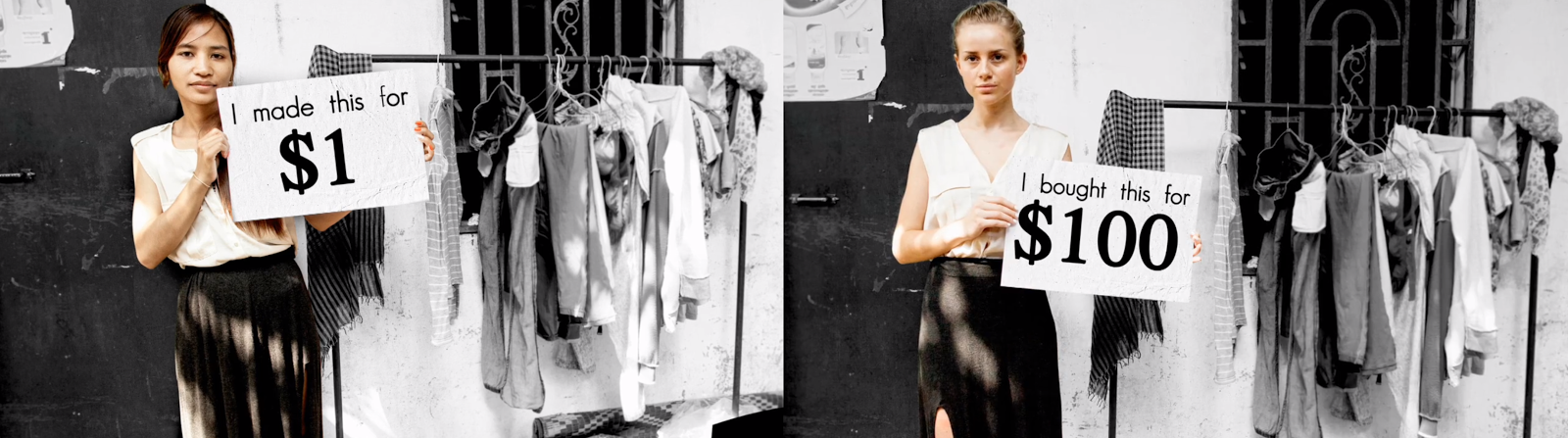
'Sweatshop' is a Norwegian Format, created by Norway's largest newspaper Aftenposten, that sends young clothes lovers to experience life for sweatshop workers in Cambodia and although it may have thrown out mixed opinions online, I absolutely loved it. It's not our usual, pack your naughty teens off to a third world country and let them see how lucky they really are, it's a wake up call to all of us and I think it has the potential to branch out to other issues too.


Spending the night with Oudum - khmertimeskh.com
What makes it even more brilliant is the fact that it exists in 10min episodes online - I think Norwegians are grasping the future of television quicker than the rest of us perhaps (even if it's not intended as such). We watch everything online now, and don't want to dedicate hours of our dwindling spare time, watching a depressing programme about how life is unfair. But in 10min stints, we find ourselves wanting to watch on, wanting to click through to the next link. And I don't think it's a format that couldn't just as easily return in Norway, but also work here in the UK. It would work to pack normal everyday people off to other cultures to learn, not what amazing sights the countries have to offer (this isn't another Joanna Lumley special) but to see what life has to offer for those whom live there. Ordinary people, meet ordinary people and create some rather spectacular television.

Not only was the platform great, the content was too. It had reasonable production value although, as contributor Ludwig shares, it was difficult trying to get any sweatshop to allow them to film. With conditions exploiting a lack of toilet facilities, lack of good food and with employees earning just $3 a day and working long hours - I wonder why!

sobadsogood.com
But the team succeeded and what came out of that, was a glimpse at what life might be like for the average working class Cambodian. We follow our three young protagonists, Frida, Ludvig and Anniken as they stand surrounded by overcrowded trucks delivering hundreds of workers to factories to earn their living. With them, we meet Oudum who earns $130 a month and pays $30 of that for a small room in Phnom Penh and with water & electricity, it often reaches up $50 a month. That's 17 days work and she works 7 days a week for between 11 & 13hours a day, except Sundays when she works for 8 hours. Oudum is incredibly blunt about her situation, she does not cry, she does not falter. She is perhaps, the strongest woman our teens have ever met.

dressedandstripped.nl
Ludvig is from Oslo, he seems like a normal laid back kind of guy, who enjoys looking good. He is moved often by the struggle of those he meets in Cambodia and seems more sympathetic to their plight than the girls. He is a character with whom the viewer can really identify and he’s very likeable.

During their stay, the three Norwegians see protests for a fair wage and are moved by the determination of the Cambodians to get up each morning and go to work. Their main plight is just for their minimum wage to increase from just £60 to £100 ($160) a month to feed their families. Ludvig was moved by this so much that he decided to tattoo this sticker used in the worker's protests, on his ankle...
Ludvig: His passion to their cause really impressed me.

so-trendy.fr
Frida is young and naïve but you can see she genuinely cares about the lack of worker’s rights and is particularly moved by a lady who tells her that her mother died of starvation when she was young. Although she is moved by the situation of those she meets, she does not seem like the type of person to act upon it. 

The teens come out with some pretty strong opinions off the back of this day spent listen to the woes of activists and garment workers:

rifeoffame.com
Frida: I had to hold her hand to show how grateful I was to hear her story.
Anniken: When you begin talking to a person you see she is just as valuable as you are… She is just 19 and she tells me that her mother died of starvation. What kind of life is that? How must it be yo begin life like that? Her mother did not die because of illness or because she was killed. She starved to death because they did not have money for food.
Ludvig: I don’t have words for it. It’s just so extremely unfair. And the truth is that we are rich because they are poor
Frida: I am just put out by all this. I never imagined these things were real.
Anniken: We will influence people to care. That is our work now.

fr-fr.facebook.com
However, I wondered for 17yr old fashion blogger Anniken, will this change anything about her career in clothes? Will it truly be her work now? She went to Cambodia having run one of the most successful blogs in Norway, with 10,000 readers a day, and hadn't paid for any clothing for a year as it was sent to her free. She was moved to tears in the programme and came to some profound conclusions about their role in motivating change, but I wondered if it would change the way she approached her blog... and indeed, her 81,000 Instagram followers - why not read her blog for yourself and see just how much of an impact it really had: http://annijor.blogg.no/
 
The programme, if it didn’t necessarily have an impact on the lives of our Norwegian teens, it certainly changed their opinion from, ‘it’s always been like this so they’re used to it’ to ‘it’s not acceptable’ and at least Anniken is standing up for the values she gained from her trip. http://www.sbs.com.au/news/article/2015/01/29/what-three-fashion-bloggers-learned-after-month-cambodian-sweatshop

And it made an impact on me. I, like so many others have an eye for a bargain, and now again it does cross our mind that people work long hours on no pay to make them for us. But you just don’t think that because you buy an item of clothing for £5, that people die of starvation because they cannot afford food. It most certainly made me think more about my love for bargains. I’d be interested to see Frida, Ludvig and Anniken a year from now and see what differences the experience really inspired in them too. 

Oudum & Anniken
The production was one of unexpected quality from my point of view with some well-chosen, and well-timed changes in tone throughout with a suitable soundtrack. Overall, I think I'm really going to look into taking a similar format on myself. It has so much potential, not only to work well as a format but also to act as aid to leverage change. Definitely can't wait to start brainstorming this one.
Make sure you watch the series yourself, go on, it's only 5 x 10mins of your life and might just change just a little part of it!

WATCH IT HERE:

Monday, 29 December 2014

Waiting for 'Superman'

Director Davis Guggenheim has been endlessly praised for his 2010 title 'Waiting for 'Superman'. The title swept the awards ceremonies clean, picking up 14 awards amongst 25 nominations. I feel however, I should have learned by now, not to trust awards when it comes to choosing documentaries to watch.

flaglerlive.com
Waiting for 'Superman' is of course a documentary that will have captured the hearts of American film festival judges, not just for bureaucratic reasons, but because they can relate to the story within the film. For us, as an audience (an overseas audience at that), it is less of a documentary, more of a visual proposal, a presentation of far too many statistics for any one person to take in first time round. Perhaps the most fitting award nomination the film received then is this one (IMDB):

Alliance of Women Film Journalists 2010

Nominated
EDA Special Mention Award
Movie You Wanted to Love, But Just Couldn't

http://www.dvdbeaver.com
Mainly I wanted to challenge the unnecessary inclusion of archive of 'The Simpsons', and 'School of Rock' that seemed to attempt to break up the endless narration that never actually arrived at a solid conclusion. Surely it's just a waste of money. Then I remembered Guggenheim made 'An Inconvenient Truth' and probably still has the money to spend on idle content. If the point was to highlight that bad education had become so much a part of the US education infrastructure that it was even embedded within popular culture, then ok, I get the link. But Guggenheim instead could have spent the time and money showing us real representations of the issues. I wanted to hear personal accounts, testimonies, not just watch yet another persons fictional interpretation of the system. Is that what the issue is, fictional?

http://www.dvdbeaver.com
It just didn't move me to want to make a difference, nor did it make me feel as though there was a way I could help at all. Although Guggenheim's graphical finale supports that no big changes have ever started in the White House, they have started with people, started with you... I felt there was nothing willing me to support the cause, nothing compelling me to do so.

The film consisted of far too many accounts of failure, far too many interviews, far too much description and narration and nowhere near enough visual evidence. I read somewhere that a good documentary will have the power to persuade you of it's cause by images alone, and 'Waiting for Superman' just didn't. I felt, nothing.

Michelle Rhee - nytimes.com


It may have taken us through some of the attempts to alter the US education system with some nice archive of Michelle Rhee in her battles against angry parents. But I had no real emotional attachment to any of our featured children that allowed me to really feel for them at their acceptance/rejections into better schools at the ever anticipated 'lottery'.


http://www.dvdbeaver.com

The film wasn't completely elusive, it had some great graphical elements and held at least one memorable moment with young Anthony who is already planning for the future of his children as his own is still being decided. But I don't think that Guggenheim completely succeeded in humanising the statistics flooding out of the academic sinkholes of the US.


graphical elements - http://www.dvdbeaver.com
Many say it's well made, others say it's an important documentary to watch, some say it compels change... I disagree. I think to compel an audience to act, they need to SEE real people's experiences, not just HEAR them. In this I don't think Guggenheim did as well as he could. It's a commentary, not a documentary. On the subject of commentary, for a film about children, I also wanted to hear a lot more from them than I did. For a film about education, I wanted to see a lot more REAL on-location footage in classrooms, like the shot of Anthony holding his hand up, rather than just that single token shot. That single shot, did not lay down a narrative of reality for me, the visuals were not enough to convince me. But that's just me. Who knows, you might think differently. 

Waiting for Superman is available on Amazon for the modest UK price of £2.86 so why not decide for yourself! http://www.amazon.co.uk/Waiting-For-Superman-Davis-Guggenheim/dp/B004OBZLO6

Thursday, 6 November 2014

Lesson 2 - Visuals are Important

Lesson number 2 from Barry Hampe - visuals are important! A commentary is merely a collection of comments made on a particular subject. What makes a documentary MORE than just a commentary, are the visuals. And here's another shortfall in my debut documentary that I now recognise.

I was so focussed on capturing the words and comments of our contributors to piece together the story, that visuals became secondary. I believed that archive reels would suitably cover the moments I failed to shoot original footage for, and it did to an extent but it took away from the personalities of our wonderful contributors and at some points felt forced.

In my approach, I now know I was wrong. The film still turned into a significant film for those involved and I feel carried the message I'd intended. It was emotive, it told the truth... but it did so verbally rather than visually and I realise now that this let it down.

Still, onwards! Learning for next time!


Tuesday, 4 November 2014

Film-making's Easy, Right?

Today I began not only reviewing factual television (if you can call my ramblings a review) but discovering how they are made. I have experience of creating my own documentary, my first documentary about a cause I care very much about. In fact you can watch it here: https://vimeo.com/94738448

It becomes clear to me each time I watch it back that its misgivings are too large to ignore. The technical aspects of the film are far from superior and the story could have been told better. Don't get me wrong, the contributors are excellent and I am immensely proud of the content over the technical ability on offer to us. I completely and wholeheartedly adore our contributors on and off screen but I am becoming ever more aware of my first film's shortfalls and am now committed to making my next film, much better.

And so, I begin my journey with a venture into Barry Hampe's 'Making Documentary Films & Reality Videos'.

Thus far I have learnt that documentary film-mkaing is far from easy. I've also learned that I wasn't far off in my first attempt but that the following things are probably useful to keep in mind when making a documentary film to ensure we get the content we really need to create a compelling film:

  • the purpose of the film
  • the kind of behaviour [we are] is trying to capture
  • what is happening in the scene being shot
  • the fact that the footage will be edited for presentation to an audience
  • how what is being shot in this scene might go with what has been shot before and what is to follow
  • how to get the best possible images and sound as visual evidence of the event
  • how far the crew can go with this and still remain on their own side of the invisible wall
Interview set-up (2 camera)
I am sure there are other things that are useful to know, such as how to interview to gain good responses, how to light the scene and how to record audio and visuals well. However, it all begins with the bullet points above. It's not as simple as pointing your camera at people and hoping they say the right things and capturing good moments on film, its about pre-empting and researching, planning to get the good stuff down the lens. It is about knowing the purpose of your film from the very beginning so that by the time you reach the edit suite, you get the same delight you get from completing a well-made jigsaw puzzle rather than the fatigue that follows the putting together of a kinder egg toy with missing pieces. You need the story all there, rather than a bunch of images and talking heads that don't amount to anything.

Of course, these things are common sense to most documentarians, but in the heat of the moment when the lights are on and the contributors are mic'd up and ready to go, when time is pressing on, it takes the very best of use producers and directors to remember the values at the doc's core and proceed.

Whatever words of wisdom I discover in my reading, I will share on this blog. So please, check back in a week or two!

'The Happiness Hypothesis'

I don't normally write blogposts about books but this time I feel as though I have to, or I won't sleep. What sounds like a self-help book is actually one of the most intelligently written publications I have ever read, so much so that I found myself regularly looking up definitions to work out what author Jonathan Haidt was talking about.

happinesshypothesis.com
What I found within this brightly coloured little book, were the keys to the kingdom. I was treated to a bundle of well-chosen, inspirational quotations promoting human understanding and the need for coherence between the sciences and humanities. What followed was a deep satisfaction for finding someone else in this universe who seemed to believe in the importance of sociology and of peace and tolerance, but not in the way that would see me confined to a country teepee around a bonfire, smoking grass and playing the didgeridoo - although that's fine too. Instead it offers an insight into the greatest psychological findings from across the globe, both ancient and contemporary, explaining not just how we find happiness in ourselves, but promoting an understanding of why humans act in the way we do, what is built into our physiological being and what we ourselves have conjured to cover our traits. It seems there is no categorical imperative for any ethical decision based upon these findings.

Our tongues are quick to lawyer the actions of our unconscious being, our biological reactions to nurture, empathy and 'divine experience' are bonds between all fellow social beings, regardless of where they may come from or which beliefs they may hold. We find honour in accepting our own misgivings, we find joy in love and love in work, we work towards virtue whilst simultaneously dismissing the virtue of others as 'pure evil' because we, through our own 'naive realism' expect that we and we alone see the world for what it truly is - regardless of whether this paragraph makes any sense to you or not, it champions how wonderfully complicated we as humans are. It depicts our very creation as a work of art to be cherished, to be studied, to be read and read it can be... all within the pages of a little yellow book (with the assistance of a dictionary).

My reading was indeed a happy experience, it made me feel somewhat lighter and has inspired me to make my own investigation using certain theories within Haidt's book. My investigation will be based around the reasoning behind the rise in entertainment television and the gradual extinction of specialist factual programming, drawing upon the psychology that accompanies the emotions we share with our TV screens and perhaps, the benefits we are denying ourselves by not experiencing adversity or disappointment through what we watch, that could consequently provide us the opportunity to learn and to grow.

I could be here all night, and I'm not convinced that writing any of this down will help me sleep but I thoroughly recommend this book. You might just stumble across your very own happiness hypothesis along the way.

Oh and help Haidt and his friends in their research by taking part in their online surveys and questionnaires here: https://www.authentichappiness.sas.upenn.edu/

Thursday, 30 October 2014

Making A Documentary - Walking the Nile


On Saturday 25th October, director Jamie Berry gave up his time to speak at the Imperial War Museum's free event 'Making a Documentary’, equipped with his trendy new laser pointer. He went on to speak about the production process of his latest work, 'Walking the Nile' which documents the year-long journey of ex-military man Levison Wood as he walks the world’s longest river. Jamie shared with us exclusive clips that may or may not exist in the final cut of the four-part series for Channel 4, as well as knowledge of logistics, research and of filming in conflict, all of which were of great interest to me, being the areas I wish to work in.

Walking the Nile - Tom McShane
The trip along the Nile meant traveling through dangerous territory. Directly, the newly independent South Sudan, with gangs, armies and rebels involved in the power struggle between the presidential contenders. With oil fields in the North and severe conflict surrounding the journey, Lev (the talent) was quite literally dodging bullets, sending Channel 4's alarm bells ringing and bringing the team's 52 page risk document complete with escape plan, into the spotlight to get Lev out. With Lev in low spirits when he arrived in Sudan the team then faced problems with this unanticipated jump in the journey and failed to secure their VISAs into Sudan. Even when problems like this occurred however, even after all of the kit was confiscated, after the team spent 24hrs under house arrest, after hotels were bugged and Lev was dehydrating in the middle of the Sahara, the production continued and they managed to capture some beautiful moments on film in return. The insight into the process doesn’t just offer up jeopardy to Lev’s outrageous attempt of walking 4250 on foot, but shows the remarkable talent of the production team in overcoming that jeopardy to complete the production.

Walking the Nile - Tom McShane
As the clips at the event were shown exclusively I won't reveal their content, I think the excitement behind the scenes is enough to whet your appetite, but you can be sure to expect unbelievable moments of cute and of crazy. There are remarkable examples of stunning scenery as well as culture, comedy, despair, elation and will. A real trip of a lifetime for us all. If you can’t wait that long then here’s a baby monkey clip to tide you over: http://www.channel4.com/programmes/walking-the-nile/videos/all/walking-the-nile-on-the-road-with-florence

Walking the Nile - Levison Wood
I think what I took from the seminar was that no production is a one-man job. Sure, Lev was the front man, a camera-op, an interviewer. Jamie was directing, editing but also counseling Lev along the way. And at every step there were researchers, contributors, production managers, security guards, fixers and camera crew all over the shot, bringing the series together. The core team were all present at the seminar too which shows what a real team effort the series was and that effort from all was evident, even in the short clips we got to sneak a peek at.

Jamie - Director
Speaking to Jamie afterwards, his advice for budding factual film-makers was to narrow down the programmes and genres you want to work in to specifics. Find the shows you want to make, research the companies that make them and email them directly. It might take 1 email, it might take 50, but if you talk about their work, as well as yours, flatter them, you will eventually be picked up. Just don't stop. It's always nice when people who've been there themselves still remember to give us newbies a little of their time, so a round of applause for Jamie!

Didi - Researcher

Didi, the researcher on the series also gave the advice to scour Talent Manager like it's the last thing you'll do. She had never worked in TV before but applied to work on the series and has not looked back since. And just for Didi if she ever reads this, your grandmother isn't the only one that can't wait to see the series!


I didn't think I was going to make it to the museum in time but having sprinted all the way from Elephant & Castle and arriving panting like I'D just walked the Nile, I'm so glad I made it. A huge thank you to the Imperial War Museum for putting on the free event. Remember to look out for 'Walking the Nile' in early 2015 and remember, no film is a one-man job, so buddy up!

Walking the Nile - Tom McShane

 See the rest of this week's IWM Film festival Programme where you can view over 20 short films for free! http://www.iwm.org.uk/film-festival-programme

Find out more about the show and the team here: http://www.channel4.com/programmes/walking-the-nile


Sunday, 13 July 2014

8 Questions to Define You

I read online the other day that there are eight questions that when answered, can define you. I was intrigued and so I set out to answer them myself, having a felt a little lost lately. Here's the result...

Are you seriously going through with this?

What's your tennis ball? (What pulls you towards it, what are you chasing after)

What am I chasing, success I suppose like any other. More than that though, happiness. In all honesty though, right now, I'm chasing me. I'm being pulled towards finding myself again, as amongst all of the excitement of growing up and finding jobs and not knowing what the hell this council tax letter ACTUALLY means, I think I lost I bit of me somewhere.

For example, I don't usually read these things on the internet and actually try to implement the findings in my life but here I am writing a blog about some article that told me these eight questions could define me again. Well, I suppose I should start somewhere...


What am I doing when I feel most beautiful?

There are two answers to this. One answer is when I am travelling or exploring. I feel... freer and feel the twinkle come back to my eyes. Kamal often says he finds me most beautiful outdoors and it's because I feel free. Even in my bedroom there are walls to keep me in but by being outside, by walking through fields or staring across mountain tops knowing that I've climbed to the top to be able to see it... that to me is beauty and in turn, makes ME feel truly beautiful too (even if the rest of the world sees a sweaty, freckly mess!)

The second answer is when I am speaking passionately about something. As part of my role as Regional Ambassador for the Holocaust Educational Trust, it means I often find myself speaking in front of large groups of people - often quite important people too! When I'm on a mission to say something or get to the bottom of something, when my adrenaline allows my confidence to soar, I feel beautiful then. I'm in my element.


What is something you believe that almost no-one agrees with you on?

Cucumber should only be eaten with salt? No, not good enough...

I suppose, that history is there for us to learn from. It's easy to dismiss history as something of the past but unless we heed history's warnings and celebrate it's offering, we will only ever repeat the mistakes of those who lived before us. People agree with me but mostly, people just think that history is about a bunch of dead people, which it is. But we'll all be dead one day, wouldn't it be nice to think that people might care about us?

Hmm what else?

I know: that the world was once one massive piece of land. It makes me really passionate about the fact that wars between us, are all wars between our own people. It's not a concept that most of us will ever adopt, but it's true nevertheless! And I will not refrain from making people aware of that. Ok, so it's not going to bring about world peace in a day but I like the notion all the same. It makes me feel less lonely.


What are your superpowers, character traits?

Superpowers... I'm not sure about. If we're looking at character traits, then we should start at my complete inability to heed my own advice. Next, we should journey to my setting of ridiculously impossible tasks that only I would consider embarking upon. Perhaps then, we could stop at my failure to believe that anything is ever finished. In terms of character traits, my brain is my worst enemy. It means I think far too much at any given minute and leaves my emotions running wild all too often, although I'm not one for letting that show.
My Best Superhero Pose

I'm not sure what my superpowers are. Kamal always says he loves that I am open to anything, so I guess that might be one. I guess another is something my lecturer told my parents at my graduation last year, in that according to him I 'have a pretty high emotional intelligence when it comes to reading people'. That's not always necessarily a good thing, it can get a bit annoying too so superpower...perhaps not. But I guess in terms of all the other questions on this list, emotional intelligence is something that's certainly going to help me approach those sensitive subjects that I wish to when film-making and one that might go some way into revealing how to get my head back in the game. It's no superpower, but it's all I got. I guess I'm quite good at climbing too.


What did you enjoy doing at the age of 10?

Playing football and writing stories.
I think that moves some way towards proving the existence of a returning rift in my personality. Which one means more to me? Two years ago I told myself that I could make documentaries as a career and keep football as a hobby. I told myself it was a lot harder to do it the other way around. That was before I realised how much of my sanity lay in playing football and playing it well at that. I do sometimes think I could very easily work a normal day job in Sainsburys or Wetherspoons and live to play football with Maidenhead Ladies again. Although, having met all the people I have and realised also how much it means to me to have something to say about society through making films, I'm not so sure the decision is that easy.

Ten year old me is still in there. I want to runaway, explore, climb trees, laugh and pretend that I don't have rent to pay every month. My inner child is not completely suffocated... oh no! The weekend is just enough enough time to rejuvenate the youth and be a little reckless with adulthood. I just sometimes wish it could last a little longer.


What are you willing to try now?

Anything and everything - except weird seafood and skydiving. I've recently realised how much I thrive on new experiences, on change, on travel. Every time I travel I return revitalised and more knowledgeable about the world which in turn, drives my passion to make documentaries about all those things you come across along the way. For example, last year I went to Israel and amongst trying Falafel and rugelach and floating in the Dead Sea, I found a hugely differing outlook on politics. It seemed odd to me that somewhere with so much conflict could be so peaceful. Similarly it seemed odd that you never heard of the conflict, which made me feel a little more uneasy about how it seemed to sit so comfortably in the foundations of society. 

Back to willingness to try - I've tried recently to stop being so sensible with my money and allow myself a little time to have fun. For the three years I've lived in London, I have always worked, always saved and not really given myself the chance to truly enjoy the city. It made it hard for me to love London. London is a very lonely place when you don't allow yourself a fiver to get the tube to where things happen. Trying this new outlook has left me feeling a little more optimistic about life in the city. 

To try, is to learn. To learn, is to see. To see, is to show.
What will I try? I don't know, anything I guess... Try me?! 


Looking back on your career 20, 30 years from now what do you want to say you have accomplished?

Again, this is a hard one for me. After making a speech at City Hall earlier this year, I was approached by a Tory canvasser who told me I'd make a good politician. My instant response - an unexpected reflex - was to say 'never'. When asked why, I said without hesitation, because you can never keep your promises to everyone. You can't win.

The amazing Susan Pollack - Holocaust Survivor
I couldn't stop thinking about that for the whole journey home. It was as if something about my desire was released within me without me planning for it. I realised then that I wanted a career that would help people. I wanted a career that would help people say what they needed to say. That for me comes with factual film-making. The films I want to make will tell of wars and of inspiration and of the past and of the future, as my recent documentary attempted to do. I want to look back on my career and say I accomplished the making of a film that really made a difference to its contributors or to its audience. The feeling I got from speaking to the holocaust survivors for my doc 'After Auschwitz' truly inspired me and from that I learned that I want to accomplish the need within me to help tell someone else's story to the world, in the hope that it might just make it, just that little bit better.


What is your sentence? (One that sums you up, who you are and what you want to achieve)

I used to be good at this. Summing up a lot of information in one sentence but as you can tell from this blogpost, it's no longer a talent I maintain. Perhaps a philosophy will do. Someone else's sentence:
'Life is easier than you think...all you have to do is: accept the impossible, do without the indispensable, bear the intolerable and be able to smile at anything'
This is something I live by, not always intentionally. My aim is always to be able to smile again. It falters. I cry. I take a deep breath and tell myself to pull myself together.

We are stronger, bigger and better than we think and thinking, is almost always the problem. I think too much. For that reason I am going to heed my own advice for the first time in as long I can remember. I'm not going to think and I will admit defeat at this question... I don't have a sentence. Perhaps one day I will. But right now, I am 21 years old and my sentence is changing.

When in Rome...