Showing posts with label poverty. Show all posts

Thursday, 19 February 2015

Nowhere to Call Home

The lovely team at The Frontline Club hosted a screening and Q&A for Jocelyn Ford's 'Nowhere to Call Home' on Monday this week. Jocelyn was told to expect some challenging questions, but she wasn't the only one who wasn't always sure about what to say.

us.audionetwork.com


tibetaninbeijing.com
'Nowhere to Call Home' was a moving testament to the power of mass media and to the way that Tibetan villages seem to have managed to shield themselves from it. Zanta is a Tibetan widow, who migrated to Beijing to sell her jewellery and create a better life for her son, away from her possessive in-laws. With her husband gone, Zanta is not only troubled by racism from the Han Chinese in Beijing, but also has to deal with the added pressure of her father-in-law, who wants her son, Yang Qing to return to him.

contented.cc
One day, Zanta was selling her jewellery on the streets of Beijing and radio reporter, Jocelyn Ford came along and talked with her. Two years later, Zanta contacted Jocelyn and asked her to take her son, she could not afford to feed him. Jocelyn, perhaps against her will at first, became more and more involved with helping Zanta and getting Yang Qing into a school and forced by the pleas of her producer and colleagues, she began filming. Jocelyn helped Zanta out of trouble with the police, she helped her argue with racist landlords about the right to rent a room and she even travelled back to Zanta's village with her, to meet her family - and Uncle Aba, the grandfather who resists sending Zanta the ID for her and her son. And all the while, Jocelyn was unsure, all the while she maintained the view that she didn't want to get involved. Too late for that Jocelyn!

nytimes.com
facebook.com
The film threw up many questions for me. As a journalist, it is perhaps the first rule in the book, not to get yourself involved with personal affairs and promise to help people where you are unsure of the outcome - in essence, not to meddle - but then I've never been one for rules. Jocelyn went ahead. With the support of her producer she captured the times she spent with Zanta on camera and even the voiceover allows us to see how unsure she was that she was doing the right thing at first. It seemed that her heart wasn't in it. I was conflicted as an audience member in trying to see whether what Jocelyn was doing was to help, or to make a film. I'm still not quite sure that even Jocelyn knew the answer to that along the way. The ethics of the film really stirred up uncertainty in me and I found it hard to appreciate some moments in the film because of that. even when young Yang Qing began calling her mama Joce, I was unsure if that was as heart-warming as perhaps it should have been. I was conflicted - which I suppose took me somewhere towards understanding Jocelyn's own conflict.
nytimes.com

Of course, I am not saying that Jocelyn doesn't care. She did for Zanta and Yang Qing what most Tibetan women would give anything for. She helped. And the power of having a foreign journalist by your side in a dispute is far greater than Zanta was, at first, aware of. It is clear by the end that Jocelyn is more invested than she was at the beginning and not just in monetary terms. She has indeed become, mama Joce to Yang Qing and a dear friend to Zanta.

Zanta is incredibly frank and Jocelyn, incredibly candid. The two hold nothing back from the audience in sharing their anger uncertainty or sadness. Yang Qing is charming to watch on screen, as although he is surrounded by controversy, his aim is still to do the things any child would do. He does share an emotional awareness for his mother's well-being, beyond that which I have seen before, comforting her and telling her not to cry. He is still however, just a child and that shines through impeccably within the film as he rides his bike around Beijing, and plays with his cousins in the village.

facebook.com
There are some nice undercover shots of Chinese employers bullying Zanta as she is Tibetan and is often wearing Tibetan clothes. I think that to me was worse than the police officers and landlords targeting her - no wonder she ends up in tears. It really is heart-breaking to watch ad know you cannot do anything to stop them. I can understand why Jocelyn felt compelled to help.

Similarly there are some nice moments where Zanta bears all to the camera, she does not hold back. Truth be told, the camera work was a little shaky in places, but as editor Gigi says in the Q&A, 'the essence was there'.

Although she may not have wanted to take on the filming in the first place, Jocelyn's nature was of course, not to decline. It was to help and then report back. The film was an achievement on her part and a great testament to the skill of her editor Gigi. She may have, at times, added jeopardy to the events that were unfolding, particularly with Uncle Aba, but ultimately she did what any of us would try to do. She helped and the film that comes out of it, is not only heart-warming because of that, but also deeply affecting when we spend so much time with our widowed mother and witness her sheer sense of will to protect and provide for her son, Yang Qing. 


Click here to see the Q&A session with director Jocelyn Ford at The Frontline Club: http://watchinabitotheatrenstuff.blogspot.co.uk/2015/02/nowhere-to-call-home-q.html

And here's the trailer:

Nowhere To Call Home: A Tibetan in Beijing (trailer) from TripodMedia on Vimeo.

Tuesday, 10 February 2015

'Sweatshop: Deadly Fashion'

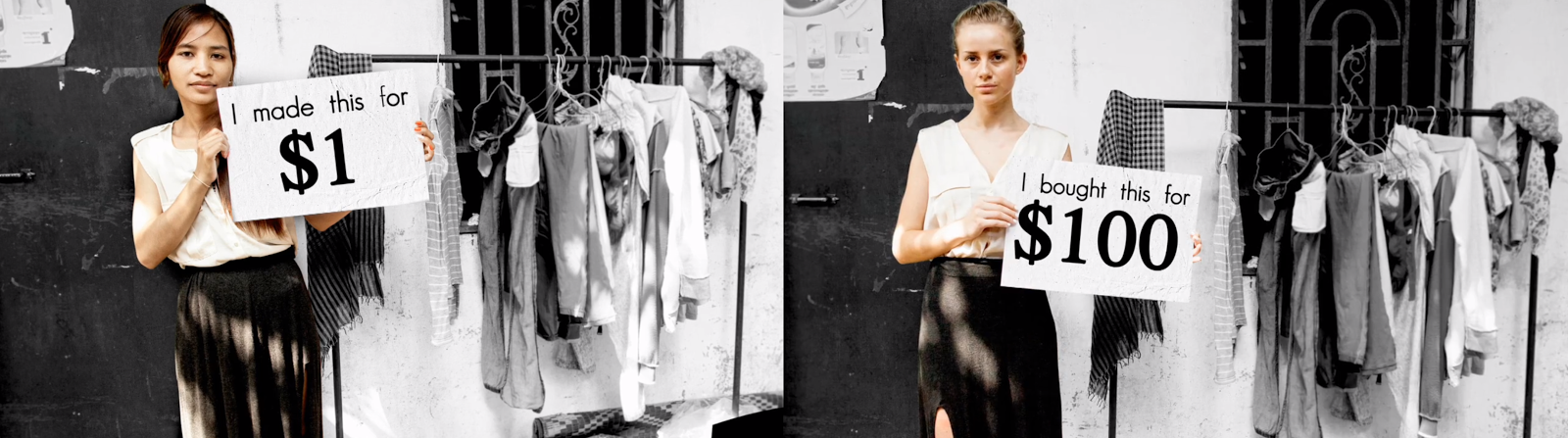
'Sweatshop' is a Norwegian Format, created by Norway's largest newspaper Aftenposten, that sends young clothes lovers to experience life for sweatshop workers in Cambodia and although it may have thrown out mixed opinions online, I absolutely loved it. It's not our usual, pack your naughty teens off to a third world country and let them see how lucky they really are, it's a wake up call to all of us and I think it has the potential to branch out to other issues too.


Spending the night with Oudum - khmertimeskh.com
What makes it even more brilliant is the fact that it exists in 10min episodes online - I think Norwegians are grasping the future of television quicker than the rest of us perhaps (even if it's not intended as such). We watch everything online now, and don't want to dedicate hours of our dwindling spare time, watching a depressing programme about how life is unfair. But in 10min stints, we find ourselves wanting to watch on, wanting to click through to the next link. And I don't think it's a format that couldn't just as easily return in Norway, but also work here in the UK. It would work to pack normal everyday people off to other cultures to learn, not what amazing sights the countries have to offer (this isn't another Joanna Lumley special) but to see what life has to offer for those whom live there. Ordinary people, meet ordinary people and create some rather spectacular television.

Not only was the platform great, the content was too. It had reasonable production value although, as contributor Ludwig shares, it was difficult trying to get any sweatshop to allow them to film. With conditions exploiting a lack of toilet facilities, lack of good food and with employees earning just $3 a day and working long hours - I wonder why!

sobadsogood.com
But the team succeeded and what came out of that, was a glimpse at what life might be like for the average working class Cambodian. We follow our three young protagonists, Frida, Ludvig and Anniken as they stand surrounded by overcrowded trucks delivering hundreds of workers to factories to earn their living. With them, we meet Oudum who earns $130 a month and pays $30 of that for a small room in Phnom Penh and with water & electricity, it often reaches up $50 a month. That's 17 days work and she works 7 days a week for between 11 & 13hours a day, except Sundays when she works for 8 hours. Oudum is incredibly blunt about her situation, she does not cry, she does not falter. She is perhaps, the strongest woman our teens have ever met.

dressedandstripped.nl
Ludvig is from Oslo, he seems like a normal laid back kind of guy, who enjoys looking good. He is moved often by the struggle of those he meets in Cambodia and seems more sympathetic to their plight than the girls. He is a character with whom the viewer can really identify and he’s very likeable.

During their stay, the three Norwegians see protests for a fair wage and are moved by the determination of the Cambodians to get up each morning and go to work. Their main plight is just for their minimum wage to increase from just £60 to £100 ($160) a month to feed their families. Ludvig was moved by this so much that he decided to tattoo this sticker used in the worker's protests, on his ankle...
Ludvig: His passion to their cause really impressed me.

so-trendy.fr
Frida is young and naïve but you can see she genuinely cares about the lack of worker’s rights and is particularly moved by a lady who tells her that her mother died of starvation when she was young. Although she is moved by the situation of those she meets, she does not seem like the type of person to act upon it. 

The teens come out with some pretty strong opinions off the back of this day spent listen to the woes of activists and garment workers:

rifeoffame.com
Frida: I had to hold her hand to show how grateful I was to hear her story.
Anniken: When you begin talking to a person you see she is just as valuable as you are… She is just 19 and she tells me that her mother died of starvation. What kind of life is that? How must it be yo begin life like that? Her mother did not die because of illness or because she was killed. She starved to death because they did not have money for food.
Ludvig: I don’t have words for it. It’s just so extremely unfair. And the truth is that we are rich because they are poor
Frida: I am just put out by all this. I never imagined these things were real.
Anniken: We will influence people to care. That is our work now.

fr-fr.facebook.com
However, I wondered for 17yr old fashion blogger Anniken, will this change anything about her career in clothes? Will it truly be her work now? She went to Cambodia having run one of the most successful blogs in Norway, with 10,000 readers a day, and hadn't paid for any clothing for a year as it was sent to her free. She was moved to tears in the programme and came to some profound conclusions about their role in motivating change, but I wondered if it would change the way she approached her blog... and indeed, her 81,000 Instagram followers - why not read her blog for yourself and see just how much of an impact it really had: http://annijor.blogg.no/
 
The programme, if it didn’t necessarily have an impact on the lives of our Norwegian teens, it certainly changed their opinion from, ‘it’s always been like this so they’re used to it’ to ‘it’s not acceptable’ and at least Anniken is standing up for the values she gained from her trip. http://www.sbs.com.au/news/article/2015/01/29/what-three-fashion-bloggers-learned-after-month-cambodian-sweatshop

And it made an impact on me. I, like so many others have an eye for a bargain, and now again it does cross our mind that people work long hours on no pay to make them for us. But you just don’t think that because you buy an item of clothing for £5, that people die of starvation because they cannot afford food. It most certainly made me think more about my love for bargains. I’d be interested to see Frida, Ludvig and Anniken a year from now and see what differences the experience really inspired in them too. 

Oudum & Anniken
The production was one of unexpected quality from my point of view with some well-chosen, and well-timed changes in tone throughout with a suitable soundtrack. Overall, I think I'm really going to look into taking a similar format on myself. It has so much potential, not only to work well as a format but also to act as aid to leverage change. Definitely can't wait to start brainstorming this one.
Make sure you watch the series yourself, go on, it's only 5 x 10mins of your life and might just change just a little part of it!

WATCH IT HERE:

Monday, 29 December 2014

Waiting for 'Superman'

Director Davis Guggenheim has been endlessly praised for his 2010 title 'Waiting for 'Superman'. The title swept the awards ceremonies clean, picking up 14 awards amongst 25 nominations. I feel however, I should have learned by now, not to trust awards when it comes to choosing documentaries to watch.

flaglerlive.com
Waiting for 'Superman' is of course a documentary that will have captured the hearts of American film festival judges, not just for bureaucratic reasons, but because they can relate to the story within the film. For us, as an audience (an overseas audience at that), it is less of a documentary, more of a visual proposal, a presentation of far too many statistics for any one person to take in first time round. Perhaps the most fitting award nomination the film received then is this one (IMDB):

Alliance of Women Film Journalists 2010

Nominated
EDA Special Mention Award
Movie You Wanted to Love, But Just Couldn't

http://www.dvdbeaver.com
Mainly I wanted to challenge the unnecessary inclusion of archive of 'The Simpsons', and 'School of Rock' that seemed to attempt to break up the endless narration that never actually arrived at a solid conclusion. Surely it's just a waste of money. Then I remembered Guggenheim made 'An Inconvenient Truth' and probably still has the money to spend on idle content. If the point was to highlight that bad education had become so much a part of the US education infrastructure that it was even embedded within popular culture, then ok, I get the link. But Guggenheim instead could have spent the time and money showing us real representations of the issues. I wanted to hear personal accounts, testimonies, not just watch yet another persons fictional interpretation of the system. Is that what the issue is, fictional?

http://www.dvdbeaver.com
It just didn't move me to want to make a difference, nor did it make me feel as though there was a way I could help at all. Although Guggenheim's graphical finale supports that no big changes have ever started in the White House, they have started with people, started with you... I felt there was nothing willing me to support the cause, nothing compelling me to do so.

The film consisted of far too many accounts of failure, far too many interviews, far too much description and narration and nowhere near enough visual evidence. I read somewhere that a good documentary will have the power to persuade you of it's cause by images alone, and 'Waiting for Superman' just didn't. I felt, nothing.

Michelle Rhee - nytimes.com


It may have taken us through some of the attempts to alter the US education system with some nice archive of Michelle Rhee in her battles against angry parents. But I had no real emotional attachment to any of our featured children that allowed me to really feel for them at their acceptance/rejections into better schools at the ever anticipated 'lottery'.


http://www.dvdbeaver.com

The film wasn't completely elusive, it had some great graphical elements and held at least one memorable moment with young Anthony who is already planning for the future of his children as his own is still being decided. But I don't think that Guggenheim completely succeeded in humanising the statistics flooding out of the academic sinkholes of the US.


graphical elements - http://www.dvdbeaver.com
Many say it's well made, others say it's an important documentary to watch, some say it compels change... I disagree. I think to compel an audience to act, they need to SEE real people's experiences, not just HEAR them. In this I don't think Guggenheim did as well as he could. It's a commentary, not a documentary. On the subject of commentary, for a film about children, I also wanted to hear a lot more from them than I did. For a film about education, I wanted to see a lot more REAL on-location footage in classrooms, like the shot of Anthony holding his hand up, rather than just that single token shot. That single shot, did not lay down a narrative of reality for me, the visuals were not enough to convince me. But that's just me. Who knows, you might think differently. 

Waiting for Superman is available on Amazon for the modest UK price of £2.86 so why not decide for yourself! http://www.amazon.co.uk/Waiting-For-Superman-Davis-Guggenheim/dp/B004OBZLO6

Thursday, 4 December 2014

World Press Exhibition


Peter Holgersson, Sweden


The female form has always been the subject of many photographers, artists and film-makers. Yet this exhibition, truly showed how it's no longer just about the bodily form, but about what women represent. In this exhibition, they shone through as representations of anything and everything.


Markus Schreiber, Germany

We had women as objects of sexual desire in the Legends Football League which shows women playing football in lingerie (which has to be the most ridiculous thing I've ever heard of). We had women as the victims of abuse in a series of photographs of a young girl, her child and her partner. We also had women as symbols of remarkable strength and willpower, particularly in the heptathlon photos of Nadja Casadei who was diagnosed with cancer yet still kept up her vigorous training programme whilst undergoing chemotherapy. And there was one image of a woman with such sadness in her eyes it brought tears to mine, as she'd waited and waited whilst access to see Nelson Mandela's casket was closed.

Fred Ramos, El Salvador
It wasn't just women though, it was great representation of humanity as a whole, bad and good. The photos leaked creativity and insight into stories from across the world, which obviously got my documentary blood pumping. There were some images that really stood out to me as I walked around the Royal Festival Hall.

One was this one, the clothes of victims of homicide showing us just how futile attempts to discover who those who once wore these clothes might be. It showed also just how unremarkable we are as humans as we disappear into the ground and leave nothing behind.


Taslima Akhter, Bangladesh

Another, was the image of the collapsed Rana Plaza building with two people, a male and a female, embracing one another as they are photographed dead amongst the rubble. No-one knows what the relationship between the two people was, but I think it shows a lot about human strength and hope, amidst a disaster that shows humanity's flaws simultaneously.


Danila Tkachenko, Russia


The next group of images really spoke to me as someone who enjoys her own company perhaps a little too much. There was a group of photos showing three men who have secluded themselves from the world and where they live. I'd be interested to know what people's reactions were to the images as to me, I felt a real sense of envy and appreciation for their freedom but I know others might have walked past and coined them 'weirdos' and that's that.


Robin Hammond, New Zealand
 The next image that stood out to me, were the images of men chained to posts and walls, forced to live outside or in the darkness of shacks with locks on, in various African countries. When I wandered nearer to read the description of why they were chained up, was met with the explanation that they were suffering from mental illness or disability and were treated this way in order to heal them. I was appalled and at the same time intrigued as to how very different cultures and understanding can be across the globe.


Peter Van Agtmael, USA
The final images that stuck out were those of Bobby Henline. As he walked down the street our photographer captured the very moment that those around him realized his disfigurement. I feel as though in this picture, each face tells a story. You can almost hear the thoughts in their heads. A frizzy haired mother looking on at him confused, a distracted father and daughter, an older brother oblivious to Bobby's presence who looks ahead to his next antic, a younger brother looking both in wonder and in fear at this bold man walking down the street. Bobby, knowing people will stare and trying to continue to walk boldly with his head held high. It really captures a story in just one second.

Carla Kogelman, The Netherlands
Goran Tomasevic, Serbia
There are so many more that really spoke to me. There were pictures of two blonde girls who had complete freedom and made me wanted to run faster than ever back to my home-town and back to my childhood. There was an image of a swimmer doing backstroke where I couldn't quite decide which part of the body was which and that strangely made it more beautiful. There were the blind albino boys in the school in West Benghal and the diver surrounded by a dark sea abyss of nothingness that was both beautiful and disconcerting simultaneously. There were pictures of the Boston marathon bombs, of wrestlers and their mothers, of organized murders in Mexico, of families taking cover on the ground of Nairobi's Westgate Mall during the massacre and incredible shots of Syrian rebel fighters taking cover from Syrian army amid debris. The images really were incredible and showed the full range of human experience. I could spend hours staring into the eyes of these timeless pictured moments.


The exhibition could really do with some video coverage, asking the viewers which photos stood out, which told a story, what they thought of certain photos. It could make a great video by engaging audience members with the photography and really making them think, just as the photographers intended.


There are so many images I couldn't include in this blog that completely broaden your perspective on life so explore them all for yourself. If you missed the exhibition at the Royal festival Hall, then visit: http://www.worldpressphoto.org/awards/2014

Saturday, 18 October 2014

Pakistan's Hidden Shame


Pakistan is considered to be one of the most developed Eastern countries and one of the few governed by democracy. Channel 4 showed us that there is a lot more to the Pakistan story than this, delving into a hidden habit of child abuse, rape and drug addiction on the streets of many cities. Over 90% of street children are said to have been raped or sexually abused, with many of the abused boys ranging from just 7-14 yrs old. 

www.rferl.mobi
The documentary is a frightening one as numerous men openly admit that they have had sex with young boys multiple times. Bus conductor Ejaz tells us of an example where a bus of about 7 grown men took turns in raping a young boy before paying him for his services. Another bus driver tells us how he rents out beds to bus drivers who drive late which is also a magnet for young children to find a bed for the night when they have nowhere else to go. He tells of how he tried to stop a man from taking a young boy and raping him before admitting to us that he too had sexually abused two young boys. 

There simply aren't words to tell of how shocked I was at how freely and openly these men admitted their crimes but it quickly became apparent that there was no feeling they would face retribution for their crime, the police simply do not have the time or care to arrest them.

We then follow the story of Naeem, 13yr old boy living on the streets of Peshawar. A boy who first sold his body when his brother beat him and told him to earn some money. He was just 8 years old. By the age of 9 he was also a drug addict and now regularly prostitutes himself to earn money to fund his heroin habit. We follow Naeem willing him to overcome his troubles but instead witness his gradual decline as he tells the camera that he too had raped a young boy. And so, the cycle starts again. It brought weight to my heart to watch, I should hate him for doing it, but can a boy who has lived surrounded by this 'norm' for almost 6yrs of his young life, be expected to know different or to feel that anyone else should be spared from the pain when he couldn't.

Imran Khan - dawn.com
It's a horrible and vicious cycle that no-one seems bothered enough by to change. Naeem is extremely brave in taking the crew to the 'best spots' for prostitution and catching men on camera trying to pay him for sex and by the end of the film we only hope that Imran Khan will stick to his word and propose change. Although it has to be said, that the film has still not seen a a local screening despite being offered free of charge.


Film-maker Mohammed Naqvi, gives an honest account about the emotional toil he suffered on completion of the film.
Now that we have completed this film, I can say unequivocally that this is by far the most emotionally trying film I have made.
I think it truly captures the life and passion of a film-maker. They care enough about the story to get it made, to hear and retell it, but only once they've switched off from telling it can they really take in what it means for them. It's a wonderfully powerful film and one that I really hope drives change in Pakistan to break this horrible web of child prostitution and drug abuse amidst incredible poverty.

Here is trailer. The complete film is still available on 4oD.


Here's a link to the director's thoughts on making the film: http://www.dawn.com/news/1130635
Here's a link to another article about the film: http://www.rferl.org/content/pakistan--hidden-shame-sex-abuse-peshawar/26574900.html