Showing posts with label photography. Show all posts

Wednesday, 6 January 2016

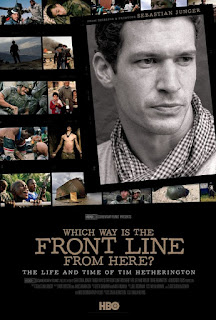
Which Way is the Front-line From Here?


When I was at Sheffield DocFest last year, I saw the Tim Hetherington Award go to Matthew Heineman, director of Cartel Land (which I'll review later). Awards like this not only exist to honour the memory of those they're named after by awarding the best documentarians of the time but they also function to introduce us newbies in the industry to the greats who came before us.

Following the award I set out to find out more about who Tim Hetherington was and came across Which Way is the Frontline From Here? There was something in this film that didn't just inspire me career-wise, but something that recognised the way I feel about about conflict. I am often asked how I can bear to watch documentary after documentary about pain, war and conflict and the only answer I've ever been able to give, is that in these films, I find more hope in humanity than I do, pain. To see humans struggle on, is something that always succeeds in getting me out of bed and committing to making a difference in the world somehow. Tim perhaps was different, it was his instinct, his nature, rather than just his passion. I have no experience to be able to know this yet. But this film shows certainly that he is someone to look to, when I think about my future.

foto8.com
Tim was a photojournalist, humanitarian and film-maker and his unique way of highlighting the plight of those often forgotten is a value I hold very dear to my heart. I have in fact just enrolled in a photography course to expand my field of vision through the lens. Tim travelled to many places, finding himself in situations he had not trained for, just felt equipped for. In Liberia, he captured the the story of war through sport. In Sierra Leone he captured those left without access to substantial healthcare and the victims of the fighters of the Revolutionary Front, who were left blinded. He found a way of capturing the stories of war that are often forgotten, through photographs that speak far louder than those we are used to in mainstream media.

pinterest.com
slate.com
artnews.com
Tim also managed to find friendship amidst the situations he found himself a part of. As his friend James put, 'he wasn't a humanitarian, or a journalist, or a photographer, he was just Tim'. He was unafraid of immersing himself in conflicts, he even stepped in to save a doctor's life when guns were pointed to his head - an act according to friends only Tim could have got away with. Then in Afghanistan, he again found himself at home within an angle of war, this time with the US army. Here he captured men in a place where they were allowed to love one another, and found innocent boys sleeping in their beds rather than the killing-machines they are often described as. Tim, despite the subject, always found the humanity in his photographs.

He continued to do so to his last moment as he chased towards the front-line in Libya, where he was killed by mortal fire alongside fellow photojournalists and civilians.

I find myself unable to say much more, how can I possibly review the making of a documentary capturing the life of a man whose job it was to do just that. The film captured moments of Tim's life we would not have seen without knowing him personally, with footage that showed him for the man he really was, a man who only ever had time for people above any form of standard journalistic practice. I'm glad I was there to see the Tim Hetherington Award presented in Sheffield, or perhaps I might never have known about the man he was and may never have learned from him the values I want to be a part of my own career in the future.

theguardian.com

Tuesday, 16 December 2014

'Eye to the Viewfinder' - One to Watch


tees.ac.uk
I first saw Paige’s film ‘Eye to the Viewfinder’ advertised as part of the Imperial War Museum’s short film festival. Unfortunately I’d missed the showing due to filming my own short documentary but managed to track Paige down, who very kindly allowed me to watch it.

And from that, Paige is definitely one to watch for the future. She had some really good interviews with a range of good contributors, including Paul Clark, a photographer with the army film unit during WW2. The colour temperature was a little different on Mick Howard's interview but I don’t think we can fault her for that amongst such a piece. The sound was flawless so I think that pulls it back.

visitmiddlesbrough.com


The strongest part of the film was when our contributors shared their combat stories, and the archive was selected to match. It added a sense of danger, of conflict and a greater appreciation for the photos and videos produced. It was a great insight into the work of the army, and its photographers. Archive was well sourced, showing a range of conflicts from Ardoyne to Iraq and I found myself lost in the photographs.


Truth be told, the narrative lacked a bit of story development at the beginning, as in, at that point I wasn’t sure what the film was trying to tell me, but by the middle I was captivated by the experiences of those on screen, particularly Stuart McKenzie and Mick Howard. Paige obviously has an eye for a story and a keen enthusiasm for sharing it with the world. What was great is that we learned about our contributors as photographers rather than as soldiers, who have to compete with the world’s media in getting their shots to the front page. The film values them, and rightly so!

Overall, a great addition to the short film festival and perhaps an even better addition to the IWM army archive? Paige I wish you luck with the rest of the film’s journey and look forward to your next film! 

Monday, 15 December 2014

The Missing Picture

'The Missing Picture' is one of the most unique documentaries I've ever seen. It is told from the point of view of one man, our narrator, as he recalls his experiences of the communist oppression of the Cambodian proletariat in the 1970s.


Vividly depicted by dynamic camera moves across clay figurines and remarkable archive reels that were interestingly camouflaged within the scenes, the film does well to keep the audience stimulated. The support of some abundantly sourced sound effects and music helped those clay lifeless people become the real people of our story, as they fell victim to the atrocities of the Khmer Rouge. We feel among them, we feel as though the narrator is speaking to us, as he does not preach, nor teach, just tells his story as remembers it.

The only images I have ever seen of Cambodia are post 1992 and therefore, the archive reels of a once bustling city and of dancers, were reels I had not expected to come from Cambodia. The nature of the film, told through the modelling of these personified clay figures, managed to turn off my reviewing senses and allow me simply to watch, to take in, to interpret and to learn.

The film was not one of fact, it did not provide an in-depth explanation of the period or regime, but it did through one man's story, encourage me to research it for myself. I found that:

  • The Khmer Rouge forced over 2 million people from their city homes, to travel to the countryside and work in the same horrendous conditions as our narrator. 
  • Since the end to the regime, over 20,000 mass graves have been found, and estimates range between 2-3million dead as a result.
  • It's thought that an additional 650,000 Cambodians died of starvation within the next year.
  • Although the Khmer Rouge were thrown out in 1979, they existed through until 1996 when they finally dissolved. 
  • What perhaps is salt in the wound, is that Pol Pot, the man in charge of running such an oppressive regime, died in 1998, having never been tried for what he'd done.
I want to know more. How is it, that I never knew the extent of Cambodian suffering during this time and how is it, that it still continues in some way today, around the world? I will certainly be devoting time towards finding out more. I hope to visit Cambodia too, where I hope to add more than just an education on it's recent history and review an understanding of what took place there.

I read once that a successful documentary is when an audience does not return with comments of how something was shown, or how it could have been shown better, but when they talk about the issue of the film. If that definition is correct, then 'The Missing Picture' remaining, is for me to agree. A brilliantly unique depiction of human suffering and resilience. One I feel I would need to watch again and again, to truly appreciate the every detail of our artist's recreation.

Thursday, 4 December 2014

World Press Exhibition


Peter Holgersson, Sweden


The female form has always been the subject of many photographers, artists and film-makers. Yet this exhibition, truly showed how it's no longer just about the bodily form, but about what women represent. In this exhibition, they shone through as representations of anything and everything.


Markus Schreiber, Germany

We had women as objects of sexual desire in the Legends Football League which shows women playing football in lingerie (which has to be the most ridiculous thing I've ever heard of). We had women as the victims of abuse in a series of photographs of a young girl, her child and her partner. We also had women as symbols of remarkable strength and willpower, particularly in the heptathlon photos of Nadja Casadei who was diagnosed with cancer yet still kept up her vigorous training programme whilst undergoing chemotherapy. And there was one image of a woman with such sadness in her eyes it brought tears to mine, as she'd waited and waited whilst access to see Nelson Mandela's casket was closed.

Fred Ramos, El Salvador
It wasn't just women though, it was great representation of humanity as a whole, bad and good. The photos leaked creativity and insight into stories from across the world, which obviously got my documentary blood pumping. There were some images that really stood out to me as I walked around the Royal Festival Hall.

One was this one, the clothes of victims of homicide showing us just how futile attempts to discover who those who once wore these clothes might be. It showed also just how unremarkable we are as humans as we disappear into the ground and leave nothing behind.


Taslima Akhter, Bangladesh

Another, was the image of the collapsed Rana Plaza building with two people, a male and a female, embracing one another as they are photographed dead amongst the rubble. No-one knows what the relationship between the two people was, but I think it shows a lot about human strength and hope, amidst a disaster that shows humanity's flaws simultaneously.


Danila Tkachenko, Russia


The next group of images really spoke to me as someone who enjoys her own company perhaps a little too much. There was a group of photos showing three men who have secluded themselves from the world and where they live. I'd be interested to know what people's reactions were to the images as to me, I felt a real sense of envy and appreciation for their freedom but I know others might have walked past and coined them 'weirdos' and that's that.


Robin Hammond, New Zealand
 The next image that stood out to me, were the images of men chained to posts and walls, forced to live outside or in the darkness of shacks with locks on, in various African countries. When I wandered nearer to read the description of why they were chained up, was met with the explanation that they were suffering from mental illness or disability and were treated this way in order to heal them. I was appalled and at the same time intrigued as to how very different cultures and understanding can be across the globe.


Peter Van Agtmael, USA
The final images that stuck out were those of Bobby Henline. As he walked down the street our photographer captured the very moment that those around him realized his disfigurement. I feel as though in this picture, each face tells a story. You can almost hear the thoughts in their heads. A frizzy haired mother looking on at him confused, a distracted father and daughter, an older brother oblivious to Bobby's presence who looks ahead to his next antic, a younger brother looking both in wonder and in fear at this bold man walking down the street. Bobby, knowing people will stare and trying to continue to walk boldly with his head held high. It really captures a story in just one second.

Carla Kogelman, The Netherlands
Goran Tomasevic, Serbia
There are so many more that really spoke to me. There were pictures of two blonde girls who had complete freedom and made me wanted to run faster than ever back to my home-town and back to my childhood. There was an image of a swimmer doing backstroke where I couldn't quite decide which part of the body was which and that strangely made it more beautiful. There were the blind albino boys in the school in West Benghal and the diver surrounded by a dark sea abyss of nothingness that was both beautiful and disconcerting simultaneously. There were pictures of the Boston marathon bombs, of wrestlers and their mothers, of organized murders in Mexico, of families taking cover on the ground of Nairobi's Westgate Mall during the massacre and incredible shots of Syrian rebel fighters taking cover from Syrian army amid debris. The images really were incredible and showed the full range of human experience. I could spend hours staring into the eyes of these timeless pictured moments.


The exhibition could really do with some video coverage, asking the viewers which photos stood out, which told a story, what they thought of certain photos. It could make a great video by engaging audience members with the photography and really making them think, just as the photographers intended.


There are so many images I couldn't include in this blog that completely broaden your perspective on life so explore them all for yourself. If you missed the exhibition at the Royal festival Hall, then visit: http://www.worldpressphoto.org/awards/2014

Sunday, 2 November 2014

More Sex Please, We're British

I only recently came across Channel 4's 2012 doc 'More Sex Please, We're British'. Now in the last few years, I've been invited to more Ann Summers parties than I count on my fingers, so what on Earth has happened to Britain's stiff upper lip - (couldn't resist).

teddy babe plush doll - lovehoney
Going behind the warehouse workings of Lovehoney, we were treated to find ordinary people with a vivacious sense of humour for dealing with their day jobs. With a sticker system for dirty phone calls and photo shoots in the boss' bedroom, it could very easily be misconstrued as seedy and inappropriate, yet the company characters charm us by speaking smutty at the dinner table and sharing their popular chat-up lines.

It might not have given us the customer access that we wanted so much to complete the picture of this £20million annual craze, but it at least gave us our first glimpse into one of Britain's most popular dirty secrets. With unrestricted access to the warehouse, the returns room, the call centre, the photoshoots, the marketing meetings and to product testing, it was interesting to watch as normal people interacted with some very abnormal everyday objects - or perhaps not so abnormal anymore. So, I may not be about to take on a Teddy Babe anytime soon but I suppose a programme that champions 'happy rabbits' over lonely hearts, can certainly do no harm.

Not a bad insight but would have loved to have had access to a few raunchy consumers for the REALLY juicy stuff!

Tuesday, 26 August 2014

Guest Post for FLETCHERWILSON - 8 Apps, 8 Days

Follow this link to FLETCHERWILSON's blog to read my reviews on the latest most popular free photography apps.
http://www.therealstorycompany.com/2014/08/8-photo-apps-in-8-days.html

Check out my photos and feel free to share your own with me @katmace11 and @FWFilm on twitter!

The faces of the Vietnam Memorial & the Berlin wall
I like this not only because of its political resonance, but it implies transcendence.