Wednesday, 11 February 2015

'The Nether' at The Duke of York's Theatre

'The Nether' - the adopted, scarily advanced grandchild of the internet. It can create sensations of touch, of smell, of sight and can even allow humans to 'cross over' into a universe we ourselves play God to. 

thenethertheplay.co.uk

I'm always a little bit dubious to believe reviews that use the words 'riveting' and 'spectacular', but true to its critics, 'The Nether' gave us everything we expected and more - more being the hour long debate me and my partner had following the show. 

theselfishyears.blogspot.com
The atmosphere within the Duke of York’s Theatre procured an essence of Charlie Brooker-esque imagination accommodated by 5 strong performances from our cast. Our actors were supported by some interesting aesthetic projections of a live video feed from a camera on the interrogation desk CS and some effective and well-executed technical transitions between the downstage 'real-world' & upstage 'The Nether'. 

'The Nether' is a play set in 2050, that explores the interrogation of the man behind the creation of a coded reality, 'The Hideaway' - a server hidden in the depths of the future of the internet (the nether), that gives paedophiles of the 'real-world' a place to act upon their urges in a false world, a secondary world. In this world, anyone can enter, so long as they adhere to the rules of 'the nether'. This means, that in 'The Hideaway', those who appear as children, are in fact adults posing as children. So is it immoral - or isn't it? Who are we to deny our escapists the chance to enter another world? Who are we to define what is imagination and what is reality?

I have invited a guest blogger, Kamal Shaddad to pick apart the concept of 'The Nether' and its morality here: http://watchinabitotheatrenstuff.blogspot.co.uk/2015/02/the-nerdy-nether.html whilst my blogpost focuses solely on the production. In doing so, I have to commend the ladies for their performances. Amanda Hale is wonderfully abrupt as our interrogator yet brilliant as our emotionally-broken daughter also. Although, even Hale is marginally overshadowed by the London debut of the young Zoe Brough as Iris.

royalcourttheatre.com
The two older members of the cast had their moments although I felt that Stanley Townsend was perhaps a little stale when compared with his co-stars. David Calder’s performance was as I expected; he gave us diffidence as well as once again attributing a remarkable naivety to his character.

I also enjoyed the performance of Ivanno Jeremiah as Professor Woodnut. He was full of energy, full of likeable physicality traits that lure us too, into the trap of ‘The Hideaway’. The relationship that blossoms between Woodnut and Iris is believable because our cast make it so. It almost feels, dare I say it, REAL.

Jennifer Haley’s script is wonderfully eloquent in both exploring the future, and in identifying and challenging our moral altruism, particularly towards children. She lures us in to the interrogation, into assuming that Morris (Hale) is in the right, and Sims (Stanley) is in the wrong. Yet as the plot unfolds, the blur between right and wrong appears more obvious. Our interrogator herself, may not be so innocent of the 'crimes' committed within 'the hideaway'. Or are they crimes? Is Iris still a child, even though she is merely coded to look as such? Will we one day have to adapt our laws to define in which reality, in which world they exist to rule? Haley boldly throws up every counter-argument in the book before it has even a chance to settle. 'The Nether' is abundantly masterful. The set-design is simple yet bold and beautiful at the same time and the sound, video and lighting provide the transitions we needed to define both worlds represented onstage.


Its 80minute running time leaves its audience wanting, which is just how a play should leave it. When the lights came on, I was still captivated and it took me a while to leave my seat. It’s been a while since I was challenged in a similar way to ‘the nether’ and it’s a welcome break to find a playwright that writes with angst, with honesty and with foresight. I can’t wait to see Haley’s next works, don’t make it too long a wait!

Remember to head over here to discover more behind the concept and moral questions 'The Nether' provokes: http://watchinabitotheatrenstuff.blogspot.co.uk/2015/02/the-nerdy-nether.html

The Nerdy Nether

Hello one and all, I’m finally making an entrance into my partner’s blog! Hurraay! I'll be making an appearance now and again to ask the questions that don't get asked, and to help debate the concepts within the content we experience. 

Recently we went and saw the play ‘The Nether', which I highly recommend for reasons my girlfriend will explain: http://watchinabitotheatrenstuff.blogspot.co.uk/2015/02/the-nether-at-duke-of-yorks-theatre.html

So, here's what I have to say: (SPOILER ALERT)

standard.co.uk
The story was incredibly engaging and really shined a light onto what many perceive as the ‘future of the internet’. So let us begin by explaining what the Nether roughly translates too. It is a sort of augmented reality similar to the world of the matrix but still has an internet feel to it. People ‘login’ which seems to completely render their bodies unconscious whilst their minds are engaged. We didn’t get to explore ‘the nether’ in its entirety as it focused entirely on one particular server, ‘The Hideaway’. Regardless of the plot this is quite interesting, where rather than servers hosting the simple web pages like we know, they now host worlds, created and coded by us. The play touched on the reality of senses and how things have advanced so much that we can seemingly trick our senses into believing that ‘the nether’ worlds are real.

esquire.com
Most people would instantly jump at the Matrix having coined this particular style of ‘the internet’ but I would have to disagree strongly. Anime films such as Ghost in the Shell (fantastic by the way) made 5 years earlier already touched on this. Many 80’s Sci-fi already included this notion of a virtual world in which we could visit as we pleased. It all sounds like something from our distant future, but actually it isn’t. Look up virtual reality gear such as the Oculus Rift or Project Morpheus by Sony and you can see that we are already heading in that direction. The main contender with it is Microsoft’s newly announced HoloLens which is an actual functioning Augmented Reality headset. This means that put the large headgear on and prepare to see holograms fit perfectly in the surroundings. The idea of an internet we can physically partake in is still far away but at least we can see the horizon. An internet like ‘the Nether’ doesn’t seem so distant now does it?

corebrain.org
But is something like this good? The point of the play was to highlight the potential way ‘the Nether’ could be abused but at the same time questioned our morality. I used to be part of online literature forum which included role-playing and for this reason, the production really resounded with me. What is reality? It’s what you see in front of you, it’s what engages your mind body and senses. Yet what if we were able to create a universe that was far more amazing than the one we were born in and we spent all our time there? If our mind, which houses all of our emotions, memory and feelings; if that could be tricked into this ‘2nd reality’, then couldn’t we argue that it is a reality? Most would disagree, most would say that Earth our planet and our universe which we can see everyday is reality. I would argue that it isn’t and that the term ‘reality’ is something subjective. When I was on those forums I completely dedicated myself to the worlds on there. Yes I knew that I was on a computer typing words to strangers far away but my imagination was what broke down the barriers. If you’re presented a world of your imagination with no perceivable barriers then who is to say that you aren’t occupying a different reality?

The Oxford dictionary’s definition of reality is ‘the state of things as they actually exist, as opposed to an idealistic or notional idea of them.’ So if we have a world made in a computer does it actually exist? Yes. Why? Because instead of atoms creating the world, it is now code (which technically is still made up of atoms just in a different way than we perceive). So any world made in ‘the Nether’ ‘technically’ is a reality. It is just up to you on far of a reality you define it. Reality is the state of things as they exist and the best example I could give you is this. If I took a child who was from the 1% of wealth in this world and took them to where the worst of the 99% lived. Their reality will have changed. Ignorance would have protected them from the horrors of poverty, disease and corruption. They would now know of those things and how they would choose to act on them would be up to them. But in the end their reality has ‘grown’ or ‘changed’.

lovetheatre.com
What makes ‘The Nether’ so interesting, is that rather than focusing on some magic world filled with elves and dragons (a memorable quote from the script is ‘have you fucked an elf before?’) it focuses on ‘the Hideaway’ a place which is similar to online forum role-play but with a darker twist. It focuses on paedophilia without resorting to graphic imagery. In ‘the Hideaway’ people get to choose from a selection of avatars and may either be adults or if lucky to be chosen, one of the cast of children who gets abused in this world. Naturally it’s wrong for this content to exist as a reality in the ‘real-world’ but here it’s all managed, used and created by adults. No actual child steps foot in the world, rather old men choose to be the children being molested. This then throws more questions into the mix. If I were to create a Netherworld, and the idea of freedom of speech exists (or in this case; creation), who is to say that the ‘creation’ should be messed with, regardless of its contents? If I adhere to ‘the Nether’ rules, surely no matter how depraving the content is, it’s still legal? It is a reality I chose to create and as such, most of us in today’s society would agree it shouldn’t be tampered with. No one should have a right to determine our dreams and imagination - But I’m being hypocritical. I hate and disagree with child molestation and paedophilla as much as the next person and would obviously want it removed from ‘reality’. But if there was a place where no ‘real’ child existed and only the images were there, that meant that the acts no longer happened in THIS reality, in THIS society, is that wrong to remove? Does it not act as a way for these people to express themselves without harming anyone?

dark5.tv
Here lies the conundrum, the main character who hates the whole idea of ‘The Nether’ ends up falling in love with one of the children (who is an actually a really old physics professor) loves the child, has sex with her (who is actually a him) captivated by the beauty and the freedom of ‘the hideaway’. The creator of the Hideaway ‘Papa’ states that because he has ‘the nether’ to escape to, he has never physically molested a child. He almost did and to prevent it from happening again he created ‘the Hideaway’.  Yet the main character continues on her path of taking the ‘Hideaway’ down.  This could all be construed as me saying that even imagery of paedophilia is acceptable. Which is not what I am saying at all. What I am saying is that for you to question reality and imagine a world in which ‘the Nether’ exists, to imagine a place where you could PHYSICALLY be a part of YOUR imagination, even if it‘s an imagination we don’t agree with, do we have the right to destroy that, to impose our will on others? If this reality has things you don’t agree with but means that in the “physical earth world” those practices will stop happening, is it okay to destroy this ‘nether’ reality and therefore force it back upon the real-world? I can’t tell you the answer since the world is not black or white and ‘the nether’ shows us just how blurred the lines and definitions of reality and morality really can be.

But I can tell you that I stand fast behind the argument that the ‘Nether worlds’ are in fact, realities and that, makes it hard for me to stomach the idea of destroying them. I’m glad to have found a play that explores just this, making us question our every moral, delve into our own definitions of reality and ultimately explore what will inevitably be, our future.


Tuesday, 10 February 2015

'Sweatshop: Deadly Fashion'

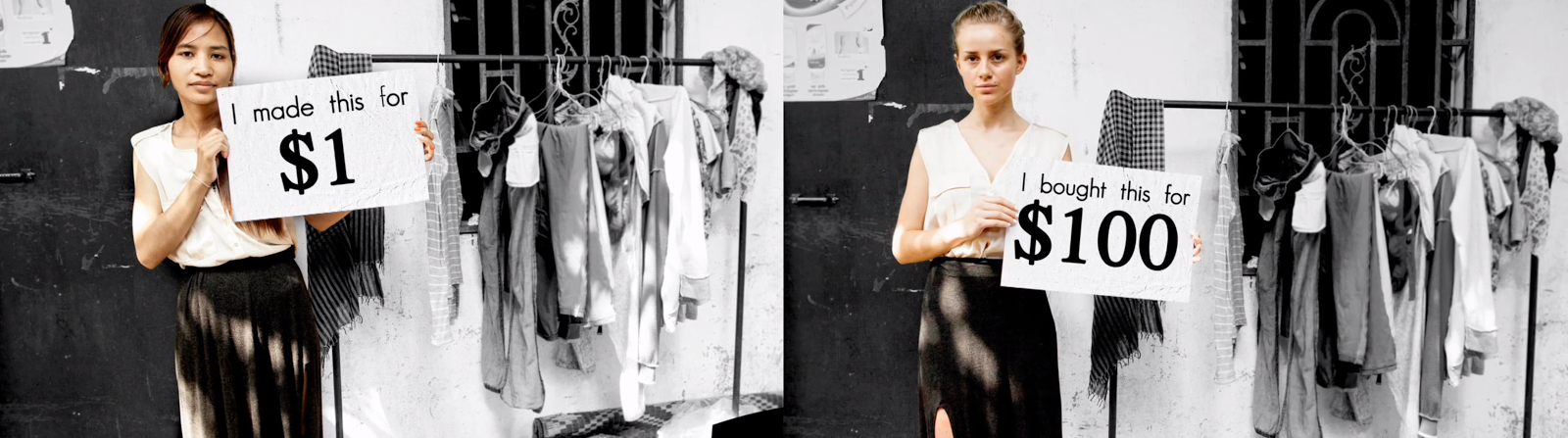
'Sweatshop' is a Norwegian Format, created by Norway's largest newspaper Aftenposten, that sends young clothes lovers to experience life for sweatshop workers in Cambodia and although it may have thrown out mixed opinions online, I absolutely loved it. It's not our usual, pack your naughty teens off to a third world country and let them see how lucky they really are, it's a wake up call to all of us and I think it has the potential to branch out to other issues too.


Spending the night with Oudum - khmertimeskh.com
What makes it even more brilliant is the fact that it exists in 10min episodes online - I think Norwegians are grasping the future of television quicker than the rest of us perhaps (even if it's not intended as such). We watch everything online now, and don't want to dedicate hours of our dwindling spare time, watching a depressing programme about how life is unfair. But in 10min stints, we find ourselves wanting to watch on, wanting to click through to the next link. And I don't think it's a format that couldn't just as easily return in Norway, but also work here in the UK. It would work to pack normal everyday people off to other cultures to learn, not what amazing sights the countries have to offer (this isn't another Joanna Lumley special) but to see what life has to offer for those whom live there. Ordinary people, meet ordinary people and create some rather spectacular television.

Not only was the platform great, the content was too. It had reasonable production value although, as contributor Ludwig shares, it was difficult trying to get any sweatshop to allow them to film. With conditions exploiting a lack of toilet facilities, lack of good food and with employees earning just $3 a day and working long hours - I wonder why!

sobadsogood.com
But the team succeeded and what came out of that, was a glimpse at what life might be like for the average working class Cambodian. We follow our three young protagonists, Frida, Ludvig and Anniken as they stand surrounded by overcrowded trucks delivering hundreds of workers to factories to earn their living. With them, we meet Oudum who earns $130 a month and pays $30 of that for a small room in Phnom Penh and with water & electricity, it often reaches up $50 a month. That's 17 days work and she works 7 days a week for between 11 & 13hours a day, except Sundays when she works for 8 hours. Oudum is incredibly blunt about her situation, she does not cry, she does not falter. She is perhaps, the strongest woman our teens have ever met.

dressedandstripped.nl
Ludvig is from Oslo, he seems like a normal laid back kind of guy, who enjoys looking good. He is moved often by the struggle of those he meets in Cambodia and seems more sympathetic to their plight than the girls. He is a character with whom the viewer can really identify and he’s very likeable.

During their stay, the three Norwegians see protests for a fair wage and are moved by the determination of the Cambodians to get up each morning and go to work. Their main plight is just for their minimum wage to increase from just £60 to £100 ($160) a month to feed their families. Ludvig was moved by this so much that he decided to tattoo this sticker used in the worker's protests, on his ankle...
Ludvig: His passion to their cause really impressed me.

so-trendy.fr
Frida is young and naïve but you can see she genuinely cares about the lack of worker’s rights and is particularly moved by a lady who tells her that her mother died of starvation when she was young. Although she is moved by the situation of those she meets, she does not seem like the type of person to act upon it. 

The teens come out with some pretty strong opinions off the back of this day spent listen to the woes of activists and garment workers:

rifeoffame.com
Frida: I had to hold her hand to show how grateful I was to hear her story.
Anniken: When you begin talking to a person you see she is just as valuable as you are… She is just 19 and she tells me that her mother died of starvation. What kind of life is that? How must it be yo begin life like that? Her mother did not die because of illness or because she was killed. She starved to death because they did not have money for food.
Ludvig: I don’t have words for it. It’s just so extremely unfair. And the truth is that we are rich because they are poor
Frida: I am just put out by all this. I never imagined these things were real.
Anniken: We will influence people to care. That is our work now.

fr-fr.facebook.com
However, I wondered for 17yr old fashion blogger Anniken, will this change anything about her career in clothes? Will it truly be her work now? She went to Cambodia having run one of the most successful blogs in Norway, with 10,000 readers a day, and hadn't paid for any clothing for a year as it was sent to her free. She was moved to tears in the programme and came to some profound conclusions about their role in motivating change, but I wondered if it would change the way she approached her blog... and indeed, her 81,000 Instagram followers - why not read her blog for yourself and see just how much of an impact it really had: http://annijor.blogg.no/
 
The programme, if it didn’t necessarily have an impact on the lives of our Norwegian teens, it certainly changed their opinion from, ‘it’s always been like this so they’re used to it’ to ‘it’s not acceptable’ and at least Anniken is standing up for the values she gained from her trip. http://www.sbs.com.au/news/article/2015/01/29/what-three-fashion-bloggers-learned-after-month-cambodian-sweatshop

And it made an impact on me. I, like so many others have an eye for a bargain, and now again it does cross our mind that people work long hours on no pay to make them for us. But you just don’t think that because you buy an item of clothing for £5, that people die of starvation because they cannot afford food. It most certainly made me think more about my love for bargains. I’d be interested to see Frida, Ludvig and Anniken a year from now and see what differences the experience really inspired in them too. 

Oudum & Anniken
The production was one of unexpected quality from my point of view with some well-chosen, and well-timed changes in tone throughout with a suitable soundtrack. Overall, I think I'm really going to look into taking a similar format on myself. It has so much potential, not only to work well as a format but also to act as aid to leverage change. Definitely can't wait to start brainstorming this one.
Make sure you watch the series yourself, go on, it's only 5 x 10mins of your life and might just change just a little part of it!

WATCH IT HERE:

Friday, 6 February 2015

Whirlygig Cinema's Spotlights: Docs

It was a freezing cold evening but I couldn’t resist heading over to Hackney Attic for Whirlygig Cinema’s Spotlights event - that this month, was focusing on docs. The evening gives 3 emerging filmmakers the chance to showcase their work for 30mins and discuss it with a live audience.


This month featured the work of LGBT activists Jackie Nunns & Angie West, Hybrid documentarian Victoria Fiore and Nepalese visual artist Asmita Shrish.

Jackie Nunns – Looking At You Productions
http://lookingatyouproductions.com/

outview.gr
Jackie Nunns began her first project with partner Angie because they were ‘curious to know about how films got into film festivals when the sound’s bad, the quality isn’t that great and you don’t know who’s gay in it’. She’s a comedic character with a commendable passion for collecting stories from within the LGBT community she is a part of.

The couple’s first film, 'Child's Play' explored the response of children, to the word 'gay'… although it didn’t go perhaps as well as they’d have hoped, seeing as most children didn’t want to talk about it. So instead, it became ‘Angie & Jackie Final Cut’, a film about how Jackie and Angie made their first film. I’m still not sure whether the concept worked for me or not, it seemed a little like a lot of the first-time films any filmmaker makes at uni but worldwide film festivals seemed to like it.
Here's what they DID manage to get from the kids:


Their next project on the showcase was ‘Mark Bunyan: Very Nearly Almost Famous’ which tells the story of gay rights activist and 70s/80s cabaret singer, Mark Bunyan. It seems that Mark’s past almost slipped under the radar completely but Jackie and Angie got in just in time and showed that in fact, we all have a story to tell and Mark’s is quite remarkable. The quality of the filming wasn’t always the best, particularly with the gentleman with the dark glasses being filmed outside. However, again, I can’t argue with ‘Frameline’, the world renowned LGBT film festival in San Francisco, LA that accepted both entries into their programme. The storyline was good and Mark certainly has led an interesting life. It's a shame there wasn't more about him as a person now as I think it could have given the audience a point in time to identify with, but all in all, it was an interesting watch and I'd like to know more about others with similar histories in LGBT activism. The production value had improved a lot since 'Child's Play' so continued  improvements are looking likely.

The two ladies certainly have an idea of the stories that should be told, my only advice would be for them to find those with sufficient technical experience, to do their stories justice – some advice I must heed too as a filmmaker myself. I have to say though ladies, I’m rather excited to see a screening of the new film about women’s arm wrestling, might even give it a go myself!


Asmita Shrish – Anahata Visions & Films
yourworldview.org.uk
Asmita is a recent NFTS graduate from Kathmandu, Nepal who specializes in documentary and wants to write scripts.

Her first film was made with a friend of hers from Kabul where her role was as post-production producer. The film followed the children of a village in northern Afghanistan and the state of their education. The children walk 2 and a half hours to school each day, taking food with them to keep their energy up. They are tired when they get to school and of course, face another 2 and half hour walk home again at the end of the day. I must say that the education seems encouraging once they are in the classroom but the class sizes are large and I doubt that after a walk like that each morning you’d have the energy to take in much information. We only saw 3mins out of the 10min film, but I’d like to see the rest. Here's the trailer: http://kalooschool.tumblr.com/post/34556042528/trailer

Then we watched a part of 'Little Nepal', filmed in Aldershot, where it’s obvious there is a large ex-Gurkha community. A contributor explains how British veterans get over £500 compensation/pension and Nepalese expats barely even get £200. They explain how they had no education so they fought in the war and now language is a problem. And so, many attend an English class to learn to communicate where necessary. One man points out that when they go to hospital, ‘we cannot understand the doctors and the doctors cannot understand us’. It’s not actually said directly, that they are Gurkhas, nor exactly what their role in the war was, which perhaps would make the film’s message a little more powerful. It is after all about language, but it carried with it an underlying social inequality issue that perhaps should be discussed more directly too.

Her third film was a clip from a film she’d shot whilst hiking in Nepal. She edited it in 1 night on the plane and is quick to apologise for any lack of clarity or quality. However, for what it was, it was a reasonable effort. The film follows a small boy who is selling peanuts and popcorn to visitors to the Chitwun National Park. She says how she was hiking and they got talking, becoming quite good friends. She also told us how he didn’t like her filming him at first. She obviously got over that hurdle quickly and we end with an observational piece on a boy we don’t quite get time to understand. It is with this statement however that Asmita had me believe I may have found my film-making soul-mate when she shares, ‘I’m not that good at camera actually, but I love people’. And that’s something that shines throughout Asmita’s work.

Finally, we are treated to 'Aunty Ganga' a film about her 67yr old aunty, who lives with her 78yr old uncle. I particularly liked with this how we saw them as people, in their natural surroundings, saying natural things, rather than just set up within an interview environment. That’s a technique I’ll be looking to use in my next film. It helped the film that Asmita’s aunty really is quite a character. She jokes that as they are old, ‘God is approving our visa, like we needed visa to come here, we are awaiting approval from god’. She's funny and what’s great is that she laughs at herself too, she makes herself laugh, which is charming. The sound was well recorded in the scenes outside, although the camera work was a little precarious. There is a serious undertone to the film in addition, with the reveal of a marriage that exists without love as we know it here in Britain, ‘we are married to the outside, but no-one knows’. She is sad and spends much time with friends to keep her spirits up. Asmita admits, ‘I bothered her much, I followed her everywhere. I was there 2 months’, but Asmita it was worth it. I think this was the best film of the bunch and it’s obvious that it’s because aunty means a lot to you, and now she means a lot to us too. Watch the film here:


Victoria Fiore – Fresco Collective
Victoria Fiore is a resident documentary filmmaker at the BFI specializing in hybrid documentaries exploring social issues, through theatre, dance and music. We began by watching a trailer of her work, in Spanish, with French subtitles, which Victoria was determined to apologise profusely for.

Victoria is a self-proclaimed traveler by nature, who has spent time with the circus and in making a film about sex workers using poetry and then her dad fell ill. He was in a coma and the day he woke up, Victoria asked him about his experiences, with the help of ‘this rubbish recorder recording his voice’. With no visuals Victoria instead swung towards Indonesian puppetry to help her create hybrid doc ‘Anesthesia’ that followed her dad’s voyage through a chemically induced black and white world. It was brilliantly done, with the sound of bells so overwhelmingly loud that it gave the impression of disorientation before it was shown visually. Perhaps a funny little insight is that her dad remains an atheist and even on visiting the land of the saint that appeared to him in his coma, he left his money and went without dwelling for even a second. Really interesting piece, watch the trailer here:


The third piece we watched was a piece about a friend of hers; a dancer who suffers from epilepsy, commonly followed by amnesia. We were asked how it made us feel. But to be honest I was actually more drawn to the fact that they were filming in the middle of a road crossing, with cars waiting to drive forwards and a flashing blue light approaching… how did you get away with that one Victoria?! Although I have to say, the dancer in the light of the headlamps was quite pleasing on the eye. Here’s the film: 


Finally we were treated to a celebration of Roma gypsy culture with ‘Gadjo’. The film is about a young boy who has grown up more for a love of football than of being a gypsy, but it’s all about getting him to fall in love with his culture, and getting us to fall in love with it too. The piece was directed by the boy’s father Dudek and Victoria agreed to take a step back and allow them to tell their own story. It wasn’t perhaps as rich as I hoped it would be. I wanted to know more about the people, about their culture now as well, but then, it wasn’t Victoria’s direction. It was dance, it was music, it was theatre, with a basis in reality - but perhaps just not enough for my liking. Check out the trailer here: 

GADJO - The Trailer from Victoria Fiore on Vimeo.


So that’s that, the films of all three of our filmmakers under the spotlight. Head over here to read about what happened when the audience grilled our film-makers about their current projects, their views on the documentary genre and what's next for them!
http://watchinabitotheatrenstuff.blogspot.co.uk/2015/02/whirlygig-cinemas-spotlights-docs-q.html

 It’s a shame that this strand is coming to an end, I’d like to see more of these kinds of events to support emerging filmmakers as there clearly is a whole realm of the documentary genre still to explore. I have high hopes for the genre and I hope to join these three in shaping the future of documentary, who knows, I might see you all again sometime. Fingers crossed we can all pull something together to come back next year, ok?

Whirlygig Cinema's Spotlights: Docs - The Q&A

After an evening of showcasing exciting new documentary ideas at Hackney Attic – the trio of female documentarians were grilled on their views of the genre, on the creation of their projects and on what we can expect from them in the future.

whirlygigcinema.com
Jackie Nunns: http://lookingatyouproductions.com/  @jacnunns
Victoria Fiore: http://victoriafiore.com/  @victoria_fiore

Why did you choose documentary as a genre for your projects?

guardian.com
Jackie: We started our own documentary obviously, we decided to make a film about children coz we work with kids and we thought that’d be easy. But of course, it wasn’t. And it was the young man who is a film-maker who helped us make the film who said, it would be much more interesting if you made a fly on the wall documentary about making this film. So, we fell into it and it was such a good experience in the sense of getting a good product at the end of it, that we stuck with it. So we’ve done 7 now and our next film is not going to be a documentary.
We’re building up to a feature which is based on a true story, so it’s not quite a documentary but it’s a true story, and we found that we needed to learn how to work with actors before you actually do the feature, otherwise it wasn’t going to work.


H: But your first film was still a documentary though, so you must have decided at one point to go that way?

Jackie: Yeh I mean, the one we’re doing at the moment is a scripted piece which is complete fantasy and that’s only so that we can practice those skills. But the features that are coming up are actually based on true events, which you can’t document in the way you’d want to in a documentary because people don’t want to be filmed, they’ve got a great story. The first feature that we’re doing is about our son’s wedding and he’s married a Turkish Muslim girl, whose family completely did not understand our relationship. So, you know, that’s very funny, it was very difficult and very funny but they were never going to be in the film, you know, they just wouldn’t. So we have to script it…so it is documentary but not quite.

Victoria: I don’t know, I just kind of fell into it coz I just want to explore. I don’t know, I prefer to explore other people’s situations than pretend that I already know what’s going on and write a script about it because I just know I’m never gonna know as much about a situation as much as someone else, and entering people’s lives, or forcing myself into people’s lives. But also, I hate writing so yeh. Probably another reason I couldn’t have the dedication to sit down and write a script. To come up with ideas and stalk people, I’m better at so that’s why I went to documentary.

yourworldview.org
Asmita: Actually I was very introvert and very shy and film-making is kind of journey for me to understand myself and it’s a kind of good way for me to get exposed to people and get connected to people. I find it very healthy for me myself, to know myself, how I can get to know humans. So that’s why I choose documentary as my first choice but I do like others as well. I do write scripts.
I am still a visual artist but I think it took me about 6 years to get into the films so, now I know I want to make films, and that’s what I want to do for the rest of life. So, it’s kind of a big journey for me.


What are the biggest challenges you found working in the genre?

Jackie: For us it’s that we have very big jobs, we’re full time and some, trying to find the time to do the job properly and outside of that it’s very hard. I think that’s the biggest challenge. Money is difficult to come by.
Host: Did you find the skills relatively easy then?
Jackie: we are project managers in our job so, it’s another project that we’ve had to learn different skills and we’ve had to acquire them quickly. But you know, there’s so much available on YouTube and books and the filmmaking community have been immensely supportive. We’re lucky to work with people who are very famous right now and helping us do our next things.

arcticdiary.wordpress.com
Victoria: I think for me, my biggest challenge is access because I’m incredibly stubborn and if I want to make a story about something, I have to make the story about THAT thing because I need, I have an urge, a deep inner urge to explore that thing but usually that takes a long time to build up trust or I don’t know. The case of the Roma family took 8 months of convincing. Now I’m making another film in Russia, trying to convince the ex-KGB to let me into this closed city or I’m doing another film now on Mauritanian slavery and all of a sudden, everyone said yes they want to appear or no they don’t want to appear so, there’s a lot of access issues but to be honest, being quite a perfectionist, stubborn Neapolitan, I kind of enjoy that challenge of forcing people to let me into their lives. It is definitely a challenge, where you have to morph and be these different people. I was always myself but you have to be different people in different circumstances and learning how to do that for me, was a challenge. But a nice challenge.

Asmita: I’m still trying to learn films so that’s my whole challenge, understanding films.


(To Victoria) How much did you direct and how much did you step back? Who made decisions over costume etc? 

makeshiftcinema.wordpress.com
Victoria: So the deal was that Dudek would direct this and the deal was that Dudek would choose everything that went in but I’d guide him along which scenes I’d like to have. So, I definitely wanted a scene where they were all singing together, definitely wanted a scene where – he explained certain types of transactions and I knew there was a horse on the campsite – so the scene about buying a horse. Certain scenes I knew that I wanted. What, we had building tents, sleeping in them at night but we didn’t use them right.
He decided what they would wear, what they would eat and how they would eat it and all of those kinds of things. And then he’d direct his family, I wouldn’t say anything. I set up the device, I set up the campsite and told them that we would just observe them and that’s as much as I did. But he chose a lot of the things. He wouldn’t have wanted to have in the film the bits where he’s observed because he didn’t realise he was being like that but then we finally got over that. Yeh he knew he was being observed and he largely directed the scenes.
I mean, it was mean to recreate old Roma gypsy lifestyle. They all had the costumes, they perform in those costumes because they’re musicians so, they choose those, I didn’t ask them to wear that.


There were a lot of public in the films, do you always get release forms from all of them?

b3media.net (Asmita at TalentLab 2014 - 3rd from left)
Asmita: Yes I do. For all the characters you mean, I did a sign from the English class, the organization that is organizing the whole class so, I had a release form from each of them that appears in the film.

Victoria: I did everywhere apart from Mexico City. But hopefully they won’t find out

Jackie: We got all of the releases except for 17secs of a song. And that took us a lot of time and it turns out that the people that wrote the song normally write for choirs, churches and schools. And they just ignored our request of permission for the 17secs so we decided to just do it anyway. We have 17secs of other music ready in case anyone ever criticizes that and we can slip it in yeh.


Asmita I wanted to ask you, how did the people particularly in the English class, show did they react to being filmed? Were they aware of the camera?

anahatsvisionsandfilms.com
Asmita: They didn’t even care that I was there. They just see me as a little girl who was just filming. I’ve been shooting that for a year now so, when I am in England I regularly go there. Now they are just cringing their faces when I show them and they don’t really care that I’m there anymore so, it’s fine.
I’ve been there for ten classes now, I’m still going, I’m still going there. It was meant to be an installation documentary actually, so there was no dialogue, just expressions and how they’re trying to communicate with each other or just trying their struggle. I really tried to tell the story, the history, the past and the present and the future through the class only and through their expression but we’ll have to see, it’s still in the edit suite.


What do you hope to do with your films, or what do you hope they will say, or change?

vimeo.com
Victoria: I do hope that, well, my aim is to screen them as much as possible right, and in that way manage to change people’s minds, especially in the most recent films. , the ones about more social issues like the Roma gypsies where there’s not a lot of things about Roma, or at least that aren’t as, subtle. I feel that I want to tell their stories more and just to get people used to it. I don’t know if I want to say something with it but just get people thinking about representation is what I’m interested in anyway. With that and other films about social issues. And just like, get the audience to have a good time and have fun. I think that’s my aim, I want it to be fun. I think that’s it really.

Jackie: Well we wanted to go to film festivals, and we got there. Yes, we’ve been all over the world. These two films in fact got into frameline, which is the number 1 LGBT film festival in the world. And we went and had this Hollywood experience which we couldn’t’ quite believe and still can’t quite believe and met all these people. There’s an international community on our Facebook now and they come to London and stay with us and one day we’ll go back to San Francisco and stay with them. It’s just been an incredibly shallow experience really.
But now that we’ve thought about it a bit more, we can see very much so, that the LGBT history month and all those sorts of things. I mean we’re very committed to that community. We’re not very interested in other things although we love to see them, but actually there’s so many stories in our community that that’s where we’d like to stay.
Mark was just saying that somebody we were about to film as part of his journey died recently, because so many of those activists are of an age where their health is precarious, their understanding of what’s going on might not be quite so good. We’re quite committed to recording that, those histories.

Asmita: I think maybe to give them something to think about, for the audience. If it touches them emotionally. That’s my aim. And also I do festivals.


How do you make your subjects comfortable in front of the camera?

vimeo.com
Jackie: I’d like to start by saying, we’ve never cracked that. The children wouldn’t talk remember. Well we went from children to Mark who is a performer so he was fine. Our most recent short is women’s arm-wrestling and that was very interesting because we filmed it at a gay club and it’s a women’s arm-wrestling night and there were people in the queue who wouldn’t be filmed. Being out is still a problem. I had this one woman who said ‘I can’t be filmed because my parents don’t know’ and all this stuff, ‘so only film me from the back’. So we had this arm-wrestling woman like this imitates awkward camera angle). Then I saw another one in the queue outside and she said ‘oh no, no, no you can’t film me, my parents don’t know’. I said ‘oh aren’t you out’ and she said ‘no, they don’t know I smoke’. So, it’s different for everybody, we’ve just got to find out what it is.

Victoria: For me, there’s a lot of negotiation involved but also I’ve made films where they don’t want to appear on camera at all and I’m just going to have to find a way out of it. But then again, I find that as really fun, and challenge how do we use film to tell their story without seeing their faces, through various techniques.
But yeh it does take a lot of negotiation. I mean I was with the Roma family for 8 months trying to convince them coz they wouldn’t appear in the film, they were really nervous about that. S that was through an agreement almost. It depends on every person you meet, everyone’s so different.
So yeh, I guess, I made them feel comfortable by spending so much time with them, drinking vodka and eating steak tartar which was great and attempting to play the violin.
[Anesthesia] in that case I couldn’t recreate the moment he was telling me anyway coz I only had this rubbish recorded, recording his voice. I recently did one about Romanian migration to the UK and none of the people on the bus wanted to be filmed. Which was, well I wanted to film the people on the bus. But, that didn’t matter because I took all their interviews and filmed scenes from the bus and then gave it to an actor who then took all of the interviews and acted them out, with projections of the bus ride. So, I mean I go around those kinds of problems trying to find solutions, which will sometimes work, sometimes.

Asmita: I think, just be honest, that’s it. I try to be honest with my characters and so, just try to be good friends with them, don’t lie to them or anything, just be honest and they’ll understand. Even after they watch the film, I mean with aunty, she’s more than happy to show it to others, with her crying. We are quite close actually.
Host: You didn’t plan for her to open up like that, that must have been hard to film…
Asmita: No, Yeh I was crying myself. It was very hard for me, very difficult for me but yeh I try to be honest, just be yourself in the situation.


How do you feel that documentary as a genre could evolve any further?

vimeo.com
Victoria: It’s so exciting right now. I find the documentary genre, so exciting, and they’ve just opened a documentary cinema at the Curzon Bloomsbury. So yeh, oh my god. Documentary is becoming so exciting right now, especially with hybrid documentary. More documentaries are being put in the cinemas now than a couple of years ago. I think it’s a super exciting place to be where the genre is being bent and people are thinking of going to the cinema to watch a documentary. That’s really cool so, I think we’re in the right moment to.
One of my things is to create a boundary between fiction and documentary. I like to play with that and there’s a lot more to play with in longer form. I don’t know there’s so much to do right now.


What would you classify as a documentary?

Victoria: I don’t know. I think, whatever you think it is then that’s enough. I mean there’s films that I think are documentaries that are mine and people are like actually what, so you’ve scripted that and that’s an actor, why’s it a documentary? But its real life represented through something. Yeh so I guess documentary is really, based on real life. But then you have a drama documentary. It’s a constant question isn’t it, what is a documentary? I just think there’s a lot more to be done and it’s really exciting.

Asmita: I think documentary exist when there is a camera and there is a character, and the character is aware there is a camera. So I don’t know if that’s documentary or fiction or... there has to be confusion of whether it’s a fiction or a documentary. But in terms of hybrid documentary, I’m not really, I don’t know about hybrid documentary but I do, do installations and projections so, that could be. There are lots of possibilities. You can work with reality, whatever, however you like.

Jackie: I cannot understand why people need to make stuff up because real life is so crazy. You just document stuff that interests you and as you both said, you get access to people who are amazing and their stories are amazing and you just film that and that’s fantastic… why do you make stuff up?

Victoria: I agree.

rainbowfilmfestival.org.uk
Mark Bunyon: There is a difference, watching footage about children taking three hours to go to school… if you see that on the 7 o’clock news it’s just news footage and there’s a split second where you go that’s amazing and awful, and then you forget it. When you come to the cinema and actually watch something, because I’ve been watching documentary programmes in film festivals and I’ve been made to watch films that I wouldn’t have actually chosen to watch. And then I’ve been really, very moved by it. I mean, the idea of taking three hours to go to school , and three hours to come back, is something that would just pass you by on television but when you’re stuck, in a seat, watching a documentary film, it has much more weight.


I’m curious because you do a lot of different styles, how do you constantly switch styles and to different audiences? How do you cater to audience?

vimeo.com
Victoria: I consider myself to be, first and foremost, a traveler. Right, traveler through genres, traveler through people’s lives. I’m not an expert on anything but I simply travel subtly through genres, styles, techniques and people. So, my curiosity in diverse things, drives me.  My curiosity in diverse techniques or in diverse stories and ways of telling stories, topics, that’s what drives me, I can’t help it. All of my stories are just absolutely crazily different. I don’t have a style per say, just because I’m too interested in everything and you can’t do everything all at once so, that’s really annoying but yeh, to just travel through these things. I do think about audiences as well but first and foremost it’s my curiosity that drives me. 

queer-streifen.blogspot.com
Jackie: We’re very committed because we’re at the other end of our lives, you’ve got so much more to come and we’ve got, what we feel, quite a short time to get a lot done if we’re going to do this. So, we’re very very focused on what we want, which is LGBT stories, and older people. We’re appealing to ourselves and those people that we know who reflect our own interests. Women film-makers are a great minority at festivals, 3% of film-makers are women, so that in itself is a challenge. Then to be focused on the queer community is a challenge. I mean we wouldn’t want to do anything simple. So, we’re doing it for ourselves and other people like us really but there’s not enough time as Victoria said, there’s not enough time to do everything.


Almost leading on from that, I don’t want to make it a focal point but I don’t think that we can ignore the fact that you’re all women sitting here tonight:
Audience: YAYYYYYY
Most of the submission that we had, a lot of documentary makers were women. I just wondered if you’d found that.
flickr.com
Jackie: No, nowhere. I don’t know why. We’re constantly having to resist men… in the film-making sense. Not in a bad way, it’s not that we don’t want to work with men or anything it’s just that certainly when our first film was made, our young man who was the film-maker, he made it and completely missed some of the female and gay stuff, because it wasn’t his community and we then decided that we wanted to work with lesbians predominantly, to make sure that our understanding of our lives is reflected in our films. Because we didn’t want to fight somebody’s, it’s not ignorance exactly, aesthetic thank you.
So it’s for that reason really. I think we feel that we have to be very niche, very targeted.

Victoria: I know a lot of women documentary directors and at documentary festivals I tend to see a lot more women, than at mixed shorts festivals where there are a lot of men. But obviously in departments like, camera, sound… I mean all tech stuff. And also I work as an editor mostly, and definitely in that field, there’s a lot more men than women. I realise it more in the directors I mean, I don’t know, my experience recently I’m meeting a whole load of female directors but less in the more technical aspects.
There’s still more work to be done right, there’s loads more work to be done.


Tell us more about what you’re doing now and what you’re working on…

unidocs.org
Asmita: I wrote a script for a small ten minutes film, so it got selected for [VERSAILLE??] international film festival. So I’m going back to my country again, to Nepal and shoot the film for ten minutes. It’s going to be premiered there which is a great opportunity for me so I’m exploring film-making more into the fiction now. And also I’m sticking also to non-fiction, and researching now climate change in the Himalayas and how it’s effecting the local communities there and yeh, that’s it. For now I’m trying to do more fiction and non-fiction and also experiment. I done two fictions before and this will be my third.

frescocollective.com
 Victoria: Well yes, one of my projects is trying to get into this closed city which they (KGB) don’t seem to be happy about letting me into. They will, one day. They won’t have a choice. Besides hat, I split my time between hybrid documentary films or which I’m working on about 3 or 4 right now, and also, another project that I’m really interested in is bringing classical music to the forefront  in the perversion of classical music videos . So yeh reinterpreting contemporary classical musicians, and giving that a view because I think there’s too much other kind of music and that doesn’t have enough prominence. So these next few months are being hopefully travelling working quite a lot on strange hybrid docs in different places which is really exciting. And a commission as well which is great, that’s the dream.

whirlygigcinema.com (Angie)
Jackie: Yeh, we’re working on two features actually. They just burst out of us and we bump into people at other film festivals and you know, you start swapping stories and you say ‘I’ll do this’ and before you know it, they’re on the phone saying ‘I couldn’t get the story out of my head, let’s do it together’ and all this stuff. So, we’re working with somebody in Canada who is in the number 1 hit lesbian film in the world, one true love, and we met her at the London LGBT festival so we’re collaborating with her and another chap in Spain so, that’s pretty exciting.
Are you in development?
I don’t know what that means still, but we’re first draft, 2nd pass of our script, whatever that means.  We’re simultaneously working on the funding and scenes and actors and so on.  I just want to say, that I’m having lunch with Lorraine Chase tomorrow, which we’re dead impressed about. The next star in our next short!