Showing posts with label national theatre. Show all posts

Thursday, 1 December 2016

Pomona

Delayed post from Nov 2015 


timeout.com
It's been a while since I've been to the Temporary Theatre. This time we arrived to see a piece staged in the round, with high hopes of tension and unease for our Saturday night entertainment. 

It started well, with heavy whirring sounds and strobe effects. We are met with a tale that hangs in the balance of chance, it seems, as our protagonist rolls dice to summon the answers she's looking for. The opening scenes show a man who seems to be homeless, throwing his ego around with a bag of McNuggets in hand, as a young girl approaches him whilst searching for her missing sister. We get the sense that there is more to this man than we first think. 

timeout.com
The tension soon dissolved with the arrival of the loveable, comical Charlie who offers a lust for adventure and friendship.....The slick entrances and exits were the only thing keeping the momentum going as we spiralled towards the end.

The story however, became less and less chilling and more and more confusing. We follow our characters through endless rounds of Dungeons and Dragons unsure of whether to take them as a metaphor for this make-believe, elaborate concrete jungle. 

We never really know where our leading lady ends up, what the purpose of her journey has been. as she escapes the clutches of whatever lurks beneath the hatches and doors of Pomona - although I'm aware that's probably the point. Has she pondered through the dungeon to find her sister or has she, all this time been looking for herself? All seems not to be quite as it should. By this time the masked monster has lost its horror, as we meet the meek woman underneath the mask and understand that she is in fact as naive as we are. It was a little underwhelming by the time the ending came - it seemed that no-one, wherever they were in the chain of command, had any idea what was really going on here - which of course meant that we as an audience remained ignorant too.

timeout.com
That meant that the tension that had been created at first, soon diffused to nothing and all we were left with were some fast entrances and exits, a lot of hearsay and the revelation that the McNugget man is implicit in this apparently menacing unknown plot.  It's a shame it didn't quite live up to its Lovecraft tin, but at another roll of the dice. Perhaps it might.

Tuesday, 15 March 2016

Waste

If going to a theatre and watching 'nothing much happen' and hearing 'too much said' amongst a cast of predominantly middle-aged men who sit down a lot, then 'Waste' is definitely one for you.

nationaltheatre.org - Johan Persson Photography
For me, it certainly wasn't. The 1927 version of the piece is filled with waste, wasted opportunity to provide drama. There is the unfulfilled drama of adultery, of a potential illegitimate child, of a rumoured affair in parliament - but actually we see none of that. The adulterer dies before she becomes a problem, the child goes with her. The father of the child dies too and alas, all hopes of an explosive second act are well and truly dusted away into the wings. It seems that every bit of potential this piece has, is not actually written into the script. It is left away from the stage leaving us willing, begging even, for the action to wake us from our cramped-seat-slumber.

nationaltheatre.org - Johan Persson
I liked the set, I'll give it that. There was at least some attempt to make the piece interesting through its transitions, stylishly marking the four acts and allowing for a masked set-change. For those moments that we saw the set changes, props were moved by maids and directed by the butler, making it seem to be simply, part of the furniture. It was like a dance to watch as they swung their arms flamboyantly. It's a shame the leads didn't catch on, instead they remain almost static throughout the entire piece. I think a smaller stage might have suited it best. It felt unused and empty, leaving me feeling distant and unengaged.

nationaltheatre.org - Johan Persson Photography
Michael Elwyn gave an amateur performance as Horsham, with absolutely no convincing authoritative trait. Gerrard McArthur gave a stronger performance as Lord Cantilupe, using his stage presence to his advantage when plotting to join the front benches for the Disestablishment Act. Olivia Williams was a little too reserved as adulterer Amy O'Connell, her flirting not nearly loud enough to convince me of her character's amorous nature. Charles Edwards did the best he could with a script that gave him nothing but words, and no feelings to exercise. Although with a man who didn't care enough to love a woman, nor enough in losing a child yet hold a revolver to his head over his career - I couldn't have cared less that he'd met his end, making it very hard to sympathise with those left behind. Oh and for goodness sake, the mourning Walter only needs to say the word 'waste' once, stop making a long play longer with more unnecessary words. We all got the point quite quickly, the affair is going to ruin his career and his life. I didn't need further repetitive sentences to clarify what the entire play had been screaming at me: WASTED OPPORTUNITIES!!!

A whopping 140mins of dilly-dally-dialogue to delay the inevitable is enough to drive the audience to suicide too. Cut-throat it most certainly was not. My verdict: 'Waste' is a waste of time - or at least 2hrs and 40mins of it.

Wednesday, 24 February 2016

Cleansed

art-sheep.com
Sarah Kane is, of course, known for her particularly dark and radical writing and is one iconic theatre writer I really wish I'd met. She's a troubled young writer of the past who, almost 20yrs later, still manages to shake up our theatre audiences, or if nothing else, certainly makes us stop abruptly to think, to analyse, to be shocked.

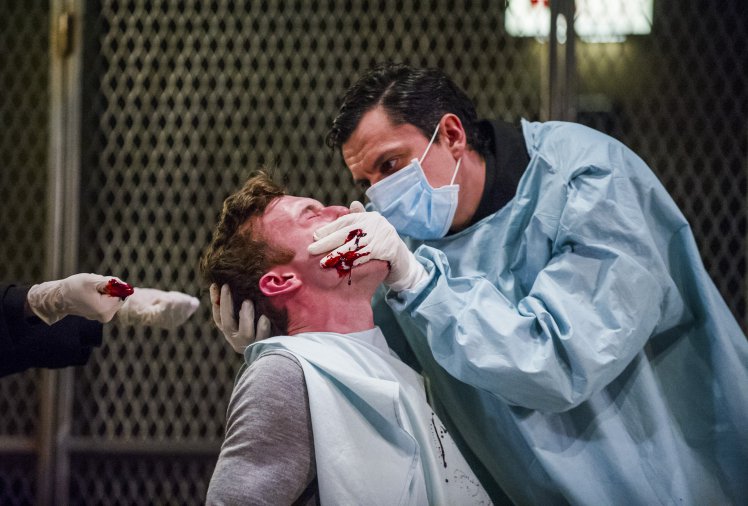
10 mins into 'Cleansed' at the Dorfman Theatre and we'd already lost two members of the audience due to fainting. That tells you most of what you need to know about a Kane theatre experience. As director, Katie Mitchell says: 'We are not shirking any of the violence requested in the stage directions'. 'Kane's stage directions request literal violence. A tongue is cut off with a pair of scissors. Hands are cut off. So how do you do that in a way that is not symbolic?' Well she found the answer to that one pretty quickly it seems. Mitchell embraces the sexual violence, ripping it from the page and brandishing it to audiences that shift uncomfortably in their seats, discover an unusual interest in the lighting rig and distract themselves by digging the dirt from beneath their fingernails - perhaps this is what Kane pictured when she titled the piece 'cleansed' -  never before have fingernails emerged so immaculate.

nationaltheatre.org.uk

SPOILERS
The production is set in what seems like a derelict school or prison facility in which it is not just the body that is trapped. The mind is too. Outside the walls of this prison there is nothing but hopelessness with the sound of bombs dropping, placing our abstract narrative amidst a world at war. The war exists inside as well, with a power hierarchy much representative of Nazi brutality during the holocaust. As Kane referenced herself, Roland Barthes said, 'when one is in love, one is in Dachau', so perhaps this informed the location that Kane needed for such a powerful and brutal, sexual message.

theartsdesk.com
The play begins with protagonist 'Grace' in a red dress, watching on as Graham begs for heroine from Tinker, the complex villain of our tale, who sadistically injects it into his eye - a bit of a metaphor for the piece really - injecting pain and brutality into the eyes of its beholders. That's where we lost audience member number one.

Grace, is looking for her brother (Graham). Her journey leads her to him, alive and well and the two duel like lovers, dancing together half-naked until Grace clambers on top of him to make love.


thestage.co.uk
Though Graham is not the only one with affection for Grace. Matthew Tennyson is marvellous as Robin, who not only looks amazing in a dress but who conveys the vulnerability of his character beautifully. He ventures out to buy Grace chocolates before Tinker catches him and feeds them to him one by one, with the same tool he'd cut Carl's tongue off with. We were watching torture, with Tinker instilling his dominance over such a likable and fragile victim. Robin struggles with his feelings for Grace, explaining that he's never been with anyone before. He exclaims 'I love you'. Grace replies 'I love you too'. He is delicate and it is a tragic moment as he shouts for help, for understanding, for someone to talk to, before ending it all with a noose made from tights. Matthew Tennyson is most definitely the highlight of this wholly unbearable experience.

metro.co.uk
We also meet two homosexual lovers, Rod and Carl. Carl declares 'I'll love you forever'. Rod can only say, 'I love you now'. He struggles with commitment. The savage nature of love places them in this facility together, as Carl is systematically tortured, his tongue cut off, his hands cut off, his feet cut off. He is forced to confront exactly what commitment to Rod meant for him, 'I love you, forever'. The very words that had placed him in this nightmare. His final torture, is also his final moment of pleasure, as Rod struggles to support him as they have sex with one another. Soon after, Rod is shot. Carl - his fate is much worse.

standard.co.uk
Our torturer Tinker is just as complex as our other characters. An exotic dancer arrives throughout the piece to perform for him, as he tries to pleasure himself, though it seems that he struggles with intimacy and instead asks, 'can we be friends?'. Grace mimics the girl's dancing, drawing attention to her quest for understanding her sexuality. Tinker is as emotionally trapped as his prisoners. He tells the woman 'I love you'. She replies 'I love you' too. They later have sex, with the girl dirty-talking as they do so, telling him she loves him, telling him to finish 'inside' - only he can't. Suddenly his villainy aligns - he is punishing those around him for their sexuality because he is unsure of his. He cannot be aroused by women or perhaps, cannot be aroused by the very nature of sexuality at all, that he so greatly despises.

nationaltheatre.org.uk
nationaltheatre.org
The final scene emerges. Tinker, out of frustration, shoots the woman dead. Grace is strapped to a bed and wheeled offstage, Carl wheeled offstage too. The two return to stun their audience as it all begins to make sense. Grace did not love her brother Graham. Not sexually anyway. Graham was the embodiment of who she wanted to be. She was trapped inside a woman's body and was screaming to find her true self, fantasising about his body. As she seeks help, she is subjected to systematic rape and violence. She tries to mimic the actions of those around her, flirting with the confusion of her gender and sexuality both at once. She explores both the female and male body and is finally confronted with her primary wish.

She reappears as Tinker reveals menacingly that the surgery is complete. He has removed Carl's sexual organs and attached them to Grace, with some very clever, if-not shocking, costume design here. She becomes Graham and despite the turmoil she's been through, says 'thank you'? This is, it seems, the harrowing and completely sickening journey of a desperate woman's journey to become who she was inside. A systematic torture centre, punishing the gender identity and sexuality of its prisoners, again as Barthes said, 'when one is in love, one is in Dachau'.

thestage.co.uk
The piece, although abstract, is extraordinarily clever. The events managing to represent ill mental health, torture, sexual desire, confusion, growth and love, all at once. It is a play about identity about pushing and pulling ourselves through our own sexual discoveries, about growing through our pain (symbolised by the sunflowers and daffodils that appear through the boards). It's about others taking pleasure in our torture and only some of us make it out the other side. Mitchell manages to give this piece new meaning with the growing conversation around transgender identity - the piece portraying the struggle, the betrayal, the hope, the torment, the torture - all parts of this tragic clambering through life in order to find our true selves.

Despite my acknowledgement of this vigorous declaration of all aspects of love and pain, one thing was certainly clear upon leaving the theatre, I felt anything but 'Cleansed'.

Sources: http://londoncalling.com/features/katie-mitchell-cleansed-national-theatre

Saturday, 10 October 2015

The Red Lion

southbanklondon.com
As I took my seat in the Dorfman Theatre, taking in the authenticity of Anthony Ward's set with its muddied walls and dirtied showers, it felt strangely familiar. The yearning I had to get myself back into one of those changing rooms - to struggle to pull my socks over my shin pads, bang my boots, to sit on one of those old battered benches - was pulling me in. The nostalgia was hitting me big time.

nationaltheatre.org
Daniel Mays lured us in further with his spectacular bitching about the state of the turf - especially around the goal-line - about referees, about pitch misconduct (we all have a story about the time THAT ref heard us call him something we shouldn't). Mays had energy like you wouldn't believe, commandeering the stage like he'd trodden its boards a thousand times. He had grit and ownership - everything a manager normally possesses - minus the chewing gum.

The first half allowed us into this male world, seething with homoeroticism that is all but celebrated yet confidently exercised. The youngest of our three man cast was Calvin Demba - playing a wayward young kid with talent on a ball and a few secrets in tow. It wasn't just a game for him, football was the place he was in control, the bit of turf he owned and the place he shone beyond his usual parameters. If there's anything I recognise, its that. That feeling you get on the pitch where everything else drifts away and for 90mins you control your own destiny. Even if it's just in your own little sunday league bubble, it's yours and you're in charge. Even on those misty winter mornings in the playground, with visible breath, wearing just a cotton school shirt and freezing my tits off - because yes, I have those. I wanted to get out on that field instantly. I was getting restless in the theatre. I felt Jordan's frustration, his worries about his knee injury, his aggression at being asked to cheat. His awkwardness at getting his kit off for a massage from another man - not that he was the only one to strip of course, all three of our men had their moment. For an actor I've only seen as a gobby little bad boy in Channel4s Youngers (which I actually loved btw) - I was suitably impressed with his command over his character. I'm quite excited by where he might go next, he's definitely one to watch.

Our cast weren't left to make drama where it wasn't written - Patrick Marber's script provided an authentic peek into a world any footballer would recognise. The line 'your sorry soul is always there to pull you back', 'he's man marking you' sticks out as one of the best. Some lines came off as a bit OTT and cheesy, but if you've ever been in a changing room it's exactly the kind of fearless prose that eeks its way into every conversation pre and post match.


Once again I was left to admire the set during the interval, where stage hands delivered scatters of ankle tape, mud and a worn-kit, filling the room with the musty smell of sweat and TCP. Even attention was given to the clock on the wall, showing that match time was over as the light outside the windows had shifted around the set. I longed to be there for real, unwinding after a game, nursing swollen ankles, with the stench of wet boots unavoidably seeping from the car boot. Again though I was awoken from my dreaming and given a story of three men who lived and breathed their club - albeit in their own way.

nationaltheatre.org
The second half was the time for our oldest cast member Peter Wight to really come into his own. The club was all Yates had, a club built on fairness and support - contradictory to Kidd who would do anything to get ahead. Whether it's three points on match day or £3000 through a dodgy transfer he was always looking to maximise potential for his reputation at the club. But our Yates was having none of it, even if it meant getting his hands dirty in the process. And dirty he did. He fights to mentor young Jordan facing direct opposition from May's character, Kidd and this time, the score line didn't matter. The most intense match was going on inside the changing room - which is why the play gets away with never showing any character playing football. The drama is already there.

nationaltheatre.org
Yates wins our hearts with his passion but by the end we're not sure who has it right. All three men have lied in the name of the sport they love BECAUSE they love it. It's hard to hate anyone by the end. We have an odd sort of hero worship going on - or maybe we just empathise.

The finale of the piece was unexpected. As Yates becomes the last of the three to get his kit off, we watch as he once again abides by the routine the audience has accustomed to. Alone in the changing rooms he plugs the plug in the wall, unreels the extension cable - but this time he keeps going. He unreels it long enough to walk it into the shower room - without the club he has nothing left - and his final moments are driven home by the sharp reality of just how much the beautiful game means to people. Even our rivals conclude that they are in fact both the same.

Marber's script gave us all of passion-filled cliches we expected but it gave us something else too. A feeling of integrity amongst the lies and an empathy for anyone who puts their heart and soul into football, on and off the pitch. It was empowering and the first thing I did when I got home is get my kit ready for training. It seems so many of us escape to this muddy-walled changing room, and The Red Lion only made me realise how much I rely on it for sanity. A beautiful ode to a beautiful game with a soft spot for anyone who immerses themselves in club life and football fanaticism - even the groundsman with the dodgy goal line!

Sunday, 24 May 2015

Light Shining in Buckinghamshire

'Light Shining in Buckinghamshire' was a bit of an odd one for me. It was hard to allow myself into a character's life when the character kept changing from preacher to parliamentarian, from army man to squire and landowner. With a sizeable cast there was absolutely no need to multirole, which confused the audience, amidst middle English language and inconsistent costume. 

nationaltheatre.org.uk - photo by Marc Brenner
The set was interesting, I'll give it merit where due. The elaborate royalist banquet table, complete with candelabras and fresh flowers in one scene. Wooden floored manor house the next. Earthy common land by the end. Regardless of whether its symbolism was intended, it represented for me, the fall of the royalist system, into parliamentary England absent of feudalism, for a time. It showed men working the land as men continue to work away at the very foundations of our country's leadership - particularly of late.

marcbrenner.co.uk

londonist.com
But props and costume were odd for me. I was always told if you're going to go period, you need to do it wholeheartedly. And I believe that's right. It's confusing and off-putting for characters to be wearing roughs, sacks and rags within the same scene as PVC raincoats and hoodies. The same inconsistency was apparent in the prop selection. Wooden crates and quills one minute, flasks and plastic cups the next. Which period are we in - or was that the point? Perhaps the choice was a conscious one, to include these modern reminders to drive the message home that the politics of change are ever constant, particularly after the recent election. I just thought that it wasn't particularly well executed and it instead came across as a lax attempt from the costume and prop designer. I found myself noticing how a red plastic crate didn't belong in the scene and it was off-putting enough to draw me away from the dialogue.

nationaltheatre.org.uk - photo by Marc Brenner
The cast was filled with strong onscreen characters, who thankfully claim the same calibre of talent onstage. Leo Bill, Adelle Leonce and Joe Caffrey were characters to highlight with a challenge coming form younger cast member Joshua James, whose energy may have convinced a passionate atheist that god was within. His command of the stage was wonderful to watch. I'll also give particular mention to Ashley McGuire who managed to evoke tears within herself, amidst a rather frantic scene. There was certainly some good inner character work going on in that head of hers. But despite our characters best efforts, we were still lost in a slightly aimless narrative of middle English parliament, telling of rebellion, rather than enacting it.

nationaltheatre.org.uk - photo by Marc Brenner
I also noticed that on stage right (and more than once) did the gathering of cast members appear on a single level, in a straight line - not nearly the calibre of positioning seen before at the Lyttleton. But it was the script I felt that let us down the most. The cast did their best with what they had and poor production choices in multi-rolling and inconsistent aesthetic, just made for a more average NT production than the stage is used to. It gained something back from me with some fantastically arranged choral music, with additional original musical-glas FX from Helen Chadwick and I wholeheartedly stand by for Joshua James' next stage appearance.

Saturday, 6 December 2014

3 Winters

Sophie Rundle & Jodie McNee - independent


'3 Winters' has endured a barrage of good reviews being considered a 'subtle epic' by TimeOut, but having spent 2hrs 40mins in the theatre, I left just as indifferent as when I arrived. The official National Theatre rating for it was 3 stars, Though I'd knock that back to two.


Siobhan Finneran - lovetheatre.com


Credit where credit's due, Jodie McNee as Alisa was full of energy and kept the audience's attention through opinionated insults towards her sister, Lucia (Sophie Rundle) and verbal attacks on political views of her father (Rawlins). Siobhan Finneran as the mother was great on stage too; tired facial expressions that said it all, comedy moments that were played out so perfectly as to suggest the growing annoyance and banter between husband and wife over the years. She was also wonderful to watch when looking after her elderly father (Laurenson). She managed the motherly position better than I have ever seen on stage. Certainly tops Brendan Coyle's performance in Mojo last year! Although on-stage husband, Adrian Rawlins, did not act with any particular conviction. It was more saying lines than acting them. 


Susan Engel & James Laurenson - dailymail
Susan Engel was among the best, as was her younger self played by Hermione Gulliford. They captured the mentality of a woman who has been locked away for all of her life as well as capturing her class in being brought up as a lady. Karolina, feels no sense of entitlement, having sent Marsha and her mother to the streets to live. But now, she is sorry and spends the next 66yrs becoming friends with Marsha's mother and living alongside as part of the Kos family. Lucy Black as Dunya with Dunya when acting alongside Charlotte Beaumont as the younger Lucia were joyous to watch as Beaumont captured the energy and excitement of a young child with a polaroid camera. Sibling rivalry was rife and it made the early years entertaining to watch. Although entertainment, or anything else, seemed to lack from the rest of the play.

3 Winters - NationalTheatre
The tale was dry. It lacked a point. It was simply a story that I felt had no purpose and therefore just didn't need to be told. It half-heartedly made a statement about hierarchy, class and entitlement but never really arrived at the point. What was it we were supposed to learn? That entitlement is false, that hypocrisy is rife or that countries prone to revolution are almost certain to face a conflict of interest and of values?


There was no resolution. I think that's my issue. The characters just went their own way which left us waiting for something to happen. And it never did. Alisa left one way and Lucia got married and went the other. What lessons were learned, we will never know.

To hand it to them, the cast did good with what they had, but they didn't have a lot to begin with.