Showing posts with label Dorfman Theatre. Show all posts

Thursday, 16 February 2017

Us/Them

Our first play of the year came a little later than usual but on Tuesday 7th Feb we travelled to the Dorfman at the National Theatre to see 60mins of 'Us/Them'.

My Theatre Mates

A family friendly show about a terror attack - doesn't quite add up when you think about it does it? But the more you do, the more you realise that Carly Wijs' direction might just be genius. All too often when we retell moments of our past, we embellish and adapt - particularly when we are children - my nearly-3-yr-old niece would of course deny this entirely.
But when children witness traumatic events, how much of it sinks in? How much do they let it? Kids are more resilient than we think, but they're also like sponges, they take in the world at a rate that dizzies us as adults. So what if, in a place they all feel safe, like at school, they endure something terrible?

National Theatre

Us/Them is directed in a way that addresses this. As we begin with chalk drawings of the school's layout, a competition of information between our two leads and some essential facts to present the provenance of our piece, we are slowly lulled into a comedic security, brimming with innocence.

However, as the piece unfolds we are pulled ever closer to the truth, the REAL terror attack on these young children on a day that held them captive for 52hrs, killing 184 children and 148 adults. But we never really get there, the truth. The truth remains suspended in the well constructed strings that span the stage amidst a maze of conclusions and childhood storytelling.

The Stage


Our leads are enthusiastic and convincing in their confidence, as well as in their coyness. As they traverse the stage energetically, we are drawn to them even if we never really know much about who they are. Chalk drawings and imaginative commentary provide the basis of the all-too-familiar 'Us and Them' argument, with seemingly no understanding of why 'they' are 'them'  and'we' are 'us' - or of why they are being held hostage in their own school.

As a family show, Us/Them definitely helps broach the subject of death in the family if you don't have a pet that's likely to kick-the-bucket anytime soon. But it's also a fun show that incorporates dance with energy that never really allows for sombreness or pain in a concentrated quantity. It's full of imagination, both in script and staging but it's story holds a truth that makes it as devastating as it is entertaining - that is if you take a moment to Google the Beslan Massacre.

Exeunt Magazine

Read more about the production and the real event here: http://www.independent.co.uk/arts-entertainment/theatre-dance/review-usthem-dorfman-national-theatre-london-the-story-of-beslan-makes-for-a-remarkable-harrowing-a7539296.html

href="https://en.wikipedia.org/wiki/Beslan_school_siege">https://en.wikipedia.org/wiki/Beslan_school_siege

Wednesday, 24 February 2016

Cleansed

art-sheep.com
Sarah Kane is, of course, known for her particularly dark and radical writing and is one iconic theatre writer I really wish I'd met. She's a troubled young writer of the past who, almost 20yrs later, still manages to shake up our theatre audiences, or if nothing else, certainly makes us stop abruptly to think, to analyse, to be shocked.

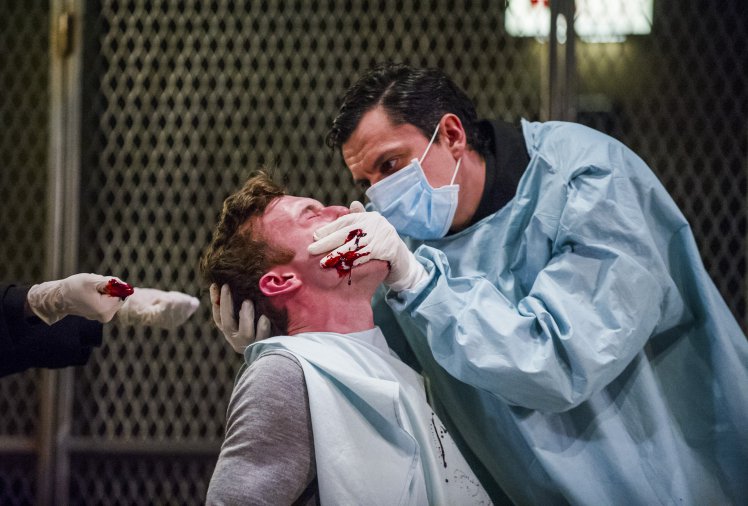
10 mins into 'Cleansed' at the Dorfman Theatre and we'd already lost two members of the audience due to fainting. That tells you most of what you need to know about a Kane theatre experience. As director, Katie Mitchell says: 'We are not shirking any of the violence requested in the stage directions'. 'Kane's stage directions request literal violence. A tongue is cut off with a pair of scissors. Hands are cut off. So how do you do that in a way that is not symbolic?' Well she found the answer to that one pretty quickly it seems. Mitchell embraces the sexual violence, ripping it from the page and brandishing it to audiences that shift uncomfortably in their seats, discover an unusual interest in the lighting rig and distract themselves by digging the dirt from beneath their fingernails - perhaps this is what Kane pictured when she titled the piece 'cleansed' -  never before have fingernails emerged so immaculate.

nationaltheatre.org.uk

SPOILERS
The production is set in what seems like a derelict school or prison facility in which it is not just the body that is trapped. The mind is too. Outside the walls of this prison there is nothing but hopelessness with the sound of bombs dropping, placing our abstract narrative amidst a world at war. The war exists inside as well, with a power hierarchy much representative of Nazi brutality during the holocaust. As Kane referenced herself, Roland Barthes said, 'when one is in love, one is in Dachau', so perhaps this informed the location that Kane needed for such a powerful and brutal, sexual message.

theartsdesk.com
The play begins with protagonist 'Grace' in a red dress, watching on as Graham begs for heroine from Tinker, the complex villain of our tale, who sadistically injects it into his eye - a bit of a metaphor for the piece really - injecting pain and brutality into the eyes of its beholders. That's where we lost audience member number one.

Grace, is looking for her brother (Graham). Her journey leads her to him, alive and well and the two duel like lovers, dancing together half-naked until Grace clambers on top of him to make love.


thestage.co.uk
Though Graham is not the only one with affection for Grace. Matthew Tennyson is marvellous as Robin, who not only looks amazing in a dress but who conveys the vulnerability of his character beautifully. He ventures out to buy Grace chocolates before Tinker catches him and feeds them to him one by one, with the same tool he'd cut Carl's tongue off with. We were watching torture, with Tinker instilling his dominance over such a likable and fragile victim. Robin struggles with his feelings for Grace, explaining that he's never been with anyone before. He exclaims 'I love you'. Grace replies 'I love you too'. He is delicate and it is a tragic moment as he shouts for help, for understanding, for someone to talk to, before ending it all with a noose made from tights. Matthew Tennyson is most definitely the highlight of this wholly unbearable experience.

metro.co.uk
We also meet two homosexual lovers, Rod and Carl. Carl declares 'I'll love you forever'. Rod can only say, 'I love you now'. He struggles with commitment. The savage nature of love places them in this facility together, as Carl is systematically tortured, his tongue cut off, his hands cut off, his feet cut off. He is forced to confront exactly what commitment to Rod meant for him, 'I love you, forever'. The very words that had placed him in this nightmare. His final torture, is also his final moment of pleasure, as Rod struggles to support him as they have sex with one another. Soon after, Rod is shot. Carl - his fate is much worse.

standard.co.uk
Our torturer Tinker is just as complex as our other characters. An exotic dancer arrives throughout the piece to perform for him, as he tries to pleasure himself, though it seems that he struggles with intimacy and instead asks, 'can we be friends?'. Grace mimics the girl's dancing, drawing attention to her quest for understanding her sexuality. Tinker is as emotionally trapped as his prisoners. He tells the woman 'I love you'. She replies 'I love you' too. They later have sex, with the girl dirty-talking as they do so, telling him she loves him, telling him to finish 'inside' - only he can't. Suddenly his villainy aligns - he is punishing those around him for their sexuality because he is unsure of his. He cannot be aroused by women or perhaps, cannot be aroused by the very nature of sexuality at all, that he so greatly despises.

nationaltheatre.org.uk
nationaltheatre.org
The final scene emerges. Tinker, out of frustration, shoots the woman dead. Grace is strapped to a bed and wheeled offstage, Carl wheeled offstage too. The two return to stun their audience as it all begins to make sense. Grace did not love her brother Graham. Not sexually anyway. Graham was the embodiment of who she wanted to be. She was trapped inside a woman's body and was screaming to find her true self, fantasising about his body. As she seeks help, she is subjected to systematic rape and violence. She tries to mimic the actions of those around her, flirting with the confusion of her gender and sexuality both at once. She explores both the female and male body and is finally confronted with her primary wish.

She reappears as Tinker reveals menacingly that the surgery is complete. He has removed Carl's sexual organs and attached them to Grace, with some very clever, if-not shocking, costume design here. She becomes Graham and despite the turmoil she's been through, says 'thank you'? This is, it seems, the harrowing and completely sickening journey of a desperate woman's journey to become who she was inside. A systematic torture centre, punishing the gender identity and sexuality of its prisoners, again as Barthes said, 'when one is in love, one is in Dachau'.

thestage.co.uk
The piece, although abstract, is extraordinarily clever. The events managing to represent ill mental health, torture, sexual desire, confusion, growth and love, all at once. It is a play about identity about pushing and pulling ourselves through our own sexual discoveries, about growing through our pain (symbolised by the sunflowers and daffodils that appear through the boards). It's about others taking pleasure in our torture and only some of us make it out the other side. Mitchell manages to give this piece new meaning with the growing conversation around transgender identity - the piece portraying the struggle, the betrayal, the hope, the torment, the torture - all parts of this tragic clambering through life in order to find our true selves.

Despite my acknowledgement of this vigorous declaration of all aspects of love and pain, one thing was certainly clear upon leaving the theatre, I felt anything but 'Cleansed'.

Sources: http://londoncalling.com/features/katie-mitchell-cleansed-national-theatre

Saturday, 10 October 2015

The Red Lion

southbanklondon.com
As I took my seat in the Dorfman Theatre, taking in the authenticity of Anthony Ward's set with its muddied walls and dirtied showers, it felt strangely familiar. The yearning I had to get myself back into one of those changing rooms - to struggle to pull my socks over my shin pads, bang my boots, to sit on one of those old battered benches - was pulling me in. The nostalgia was hitting me big time.

nationaltheatre.org
Daniel Mays lured us in further with his spectacular bitching about the state of the turf - especially around the goal-line - about referees, about pitch misconduct (we all have a story about the time THAT ref heard us call him something we shouldn't). Mays had energy like you wouldn't believe, commandeering the stage like he'd trodden its boards a thousand times. He had grit and ownership - everything a manager normally possesses - minus the chewing gum.

The first half allowed us into this male world, seething with homoeroticism that is all but celebrated yet confidently exercised. The youngest of our three man cast was Calvin Demba - playing a wayward young kid with talent on a ball and a few secrets in tow. It wasn't just a game for him, football was the place he was in control, the bit of turf he owned and the place he shone beyond his usual parameters. If there's anything I recognise, its that. That feeling you get on the pitch where everything else drifts away and for 90mins you control your own destiny. Even if it's just in your own little sunday league bubble, it's yours and you're in charge. Even on those misty winter mornings in the playground, with visible breath, wearing just a cotton school shirt and freezing my tits off - because yes, I have those. I wanted to get out on that field instantly. I was getting restless in the theatre. I felt Jordan's frustration, his worries about his knee injury, his aggression at being asked to cheat. His awkwardness at getting his kit off for a massage from another man - not that he was the only one to strip of course, all three of our men had their moment. For an actor I've only seen as a gobby little bad boy in Channel4s Youngers (which I actually loved btw) - I was suitably impressed with his command over his character. I'm quite excited by where he might go next, he's definitely one to watch.

Our cast weren't left to make drama where it wasn't written - Patrick Marber's script provided an authentic peek into a world any footballer would recognise. The line 'your sorry soul is always there to pull you back', 'he's man marking you' sticks out as one of the best. Some lines came off as a bit OTT and cheesy, but if you've ever been in a changing room it's exactly the kind of fearless prose that eeks its way into every conversation pre and post match.


Once again I was left to admire the set during the interval, where stage hands delivered scatters of ankle tape, mud and a worn-kit, filling the room with the musty smell of sweat and TCP. Even attention was given to the clock on the wall, showing that match time was over as the light outside the windows had shifted around the set. I longed to be there for real, unwinding after a game, nursing swollen ankles, with the stench of wet boots unavoidably seeping from the car boot. Again though I was awoken from my dreaming and given a story of three men who lived and breathed their club - albeit in their own way.

nationaltheatre.org
The second half was the time for our oldest cast member Peter Wight to really come into his own. The club was all Yates had, a club built on fairness and support - contradictory to Kidd who would do anything to get ahead. Whether it's three points on match day or £3000 through a dodgy transfer he was always looking to maximise potential for his reputation at the club. But our Yates was having none of it, even if it meant getting his hands dirty in the process. And dirty he did. He fights to mentor young Jordan facing direct opposition from May's character, Kidd and this time, the score line didn't matter. The most intense match was going on inside the changing room - which is why the play gets away with never showing any character playing football. The drama is already there.

nationaltheatre.org
Yates wins our hearts with his passion but by the end we're not sure who has it right. All three men have lied in the name of the sport they love BECAUSE they love it. It's hard to hate anyone by the end. We have an odd sort of hero worship going on - or maybe we just empathise.

The finale of the piece was unexpected. As Yates becomes the last of the three to get his kit off, we watch as he once again abides by the routine the audience has accustomed to. Alone in the changing rooms he plugs the plug in the wall, unreels the extension cable - but this time he keeps going. He unreels it long enough to walk it into the shower room - without the club he has nothing left - and his final moments are driven home by the sharp reality of just how much the beautiful game means to people. Even our rivals conclude that they are in fact both the same.

Marber's script gave us all of passion-filled cliches we expected but it gave us something else too. A feeling of integrity amongst the lies and an empathy for anyone who puts their heart and soul into football, on and off the pitch. It was empowering and the first thing I did when I got home is get my kit ready for training. It seems so many of us escape to this muddy-walled changing room, and The Red Lion only made me realise how much I rely on it for sanity. A beautiful ode to a beautiful game with a soft spot for anyone who immerses themselves in club life and football fanaticism - even the groundsman with the dodgy goal line!