Here's the complete winner's list. Well... I got a few right (see results in red):
Best Doc on Contemporary Theme (Domestic): How To Die: Simon's Choice
Best Doc on Contemporary Theme (International): How To Change the World
Best Doc on Current Affairs: The World: Outbreak - The Truth About Ebola
Best Arts Doc: Amy
Best Historical Doc: Attacking the Devil
Best Science Doc: Oak Tree: Nature's Greatest Survivor
Best Natural History Doc: The Hunt: The Hardest Challenge
Best Entertaining Documentary: Secret life of 4, 5 and 6 Year Olds
Best Doc Series: The Murder Detectives
Best Constructed Doc Series: The Real Marigold Hotel
Best Cinema Doc: Cartel Land
Best Newcomer Doc: Where You're Meant To Be
Best Student Doc: Women in Sink
Best Doc Presenter: Paul Mayhew-Archer
Grierson Trutees Award: Louis Theroux
It's been another great year for factual film and television, providing me with all of the inspiration I need to grow my own factual career. These are the best of the bunch and I can only watch and learn from them all in the hope that one day, I might be even half as successful.
Showing posts with label Sheffield DocFest. Show all posts
Showing posts with label Sheffield DocFest. Show all posts
Tuesday, 8 November 2016

Friday, 2 October 2015
A Sinner in Mecca
Parvez Sharma's A Sinner in Mecca - described as a hajj of defiance, screened at this year's Sheffield DocFest earlier this year, to a full house.
Sharma had a lot to live up to following his previous film 'A Jihad for Love' where he documented the lives of gay, lesbian and transgender Muslims, who choose to remain faithful to Islam, and some in countries where many would choose to flee. Sharma decided it was time to fulfil his Hajj, only he had a secret, Parvez Sharma is a gay man, which carries with it more than the threat of being caught with a camera, but also the threat of death. Sharma confesses, 'I was done coming out as a gay man, I needed to come out as a Muslim' and that is exactly what A Sinner in Mecca set out to do - all-be-it rather indignantly. The 79min film is almost entirely shot on an Iphone, with various rules in place that would make it difficult to film on anything less discreet.
However, if the aim was to prove himself as a Muslim, to come out devout to his faith, I felt that from start to finish the film was riveted with skepticism and tied together only by a slightly biased reaction to an only partly-authentic journey. Of course I expected him to be on his guard, he was filming and hiding the fact he was a gay man. Sharma has even received personalised death threats following the world premiere of his film in Canada. He does however, hold some form of a grudge against the faith that has caused many to shun him, or at least against the misinterpretation of that faith.
For example, the Saudi shopping malls, the litter covering the streets of Mecca, the air-conditioned corridor that represents the journey between the desert hills of Al-Safa and Al-Marwah. Sure, that's enough to cause us all to question the authenticity of the pilgrimage. However, it was the way in which Sharma proceeded to sacrifice a goat despite his ill-feeling, to judge a father for teaching his children to throw an incorrect number of stones at 'the devil', to question what the hajj has become in order to cater for the millions of pilgrims each year. He even captured what should have been, and is for so many Muslims, the holiest moment of the Hajj, by touching the Kaaba and with iPhone in hand it felt like the least sincere moment of the film. It felt like an intrusion of the faith of those around him and as though he had no care for it at all. The film was still more important. It was his own Hajj of defiance against those other Muslims who judge him for being gay, and he was judging them right back. He too was measuring his fellow Pilgrims' 'Muslim-ness' to use a term I've seen in conversation. It was Sharma's skeptism towards this, his constant awareness of it, and his need to tell the camera of it, that actually persisted to convince me that Sharma was not proving his faith in his religion, but more disproving it. How can he comment on the sacredness and sanctity of the Hajj if he spends most of his time moving from socket to socket to charge his own iphone, to ultimately, make a film - which was the predominant reason for going after all. Perhaps that is why filming is prohibited in the first place - as the holy city is a place of spirituality, and capturing it as a mere visual image to show family and friends, or to fulfil a predetermined conclusion (or at least partially determined) is not a true reflection on the holy city, nor on the sacredness of the Hajj. Of course, I will never know or be able to form my own opinion on this, I cannot see it for myself, I am not a Muslim. So instead, Sharma is the best hope we have.
I'd be lying if I said I didn't agree with him in places. Walking up and down an air-conditioned corridor is a far cry from what it is supposed to represent, and the litter within the holy city does beg to ask how holy a city it is if men will drop their litter on its grounds, but we've seen the aftermath of music festivals and street marches of only a few thousand, Mecca must welcome millions to its streets.

The personal journey was present at times. There were moments where Sharma found his sprituality, or at least recognised the value of being a part of a world-wide Muslim community coming together. It was hugely powerful to witness these moments in him and I felt that I learned much more about 'coming out as a Muslim' when he allowed himself to fulfil his emotional potential within his surroundings.
 The film has reached much critical acclaim, and I feel as though I am in no place to revere it as anything less than the powerful documentary they claim it to be. It suffered from poor sound quality at times with a high pitched repetitive recurring sound that seemed to find its way into the mix often but considering it was filmed on an Iphone, I couldn't fault it any further. Although I would question the legitimacy of its narrative voice, I highly disagree with the amount of hate mail that has been directed at him for portraying his own journey, particularly when it comes to his sexuality. This is after all, Sharma's story and not one that should represent the Hajj of any other pilgrim. It's nice to know though, that wherever hate mail exists, there is someone there to fight Sharma's corner... it seems that his coming out as a Muslim has seen him welcomed after all. But at what cost? He spends 80mins telling us he was losing his faith rather than strengthening it and hen concludes that by the end he is a better Muslim - how'd he work that one out? He's no better than those who judge him. He almost makes it worse for himself, framing himself as a kind of martyr, 'Islam is at war with itself and I have fought hard not to be a casualty' he says.
You can catch 'A Sinner in Mecca' on Netflix and it's definitely worth a watch. It really is a conversation starter, and a film that really gets you thinking about self-discovery. It's a rather intrusive 80min portrayal of the Hajj and its pilgrims and an equally judgemental narrative but worth a watch all the same, even if only to disagree with Sharma.
 |
| theguardian.com |
 |
| outlandic.com |
 |
| nytimes.com |
 |
| cbc.ca |
I'd be lying if I said I didn't agree with him in places. Walking up and down an air-conditioned corridor is a far cry from what it is supposed to represent, and the litter within the holy city does beg to ask how holy a city it is if men will drop their litter on its grounds, but we've seen the aftermath of music festivals and street marches of only a few thousand, Mecca must welcome millions to its streets.

The personal journey was present at times. There were moments where Sharma found his sprituality, or at least recognised the value of being a part of a world-wide Muslim community coming together. It was hugely powerful to witness these moments in him and I felt that I learned much more about 'coming out as a Muslim' when he allowed himself to fulfil his emotional potential within his surroundings.
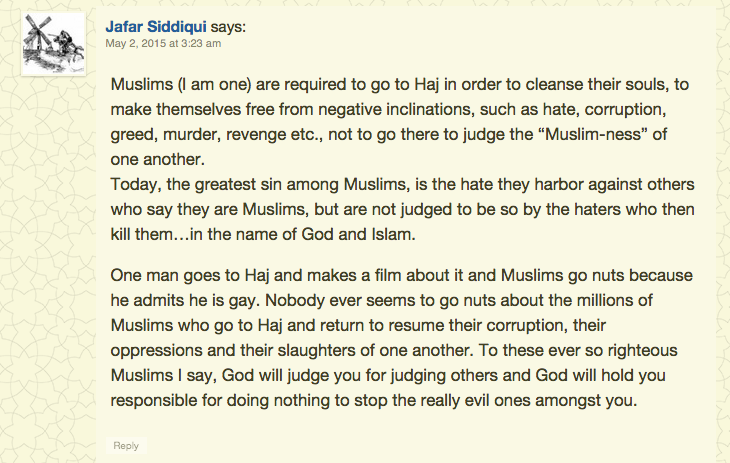
You can catch 'A Sinner in Mecca' on Netflix and it's definitely worth a watch. It really is a conversation starter, and a film that really gets you thinking about self-discovery. It's a rather intrusive 80min portrayal of the Hajj and its pilgrims and an equally judgemental narrative but worth a watch all the same, even if only to disagree with Sharma.
Thursday, 16 July 2015
The Divide
'The Divide' is more a collage of story and opinion than a structured documentary with a conclusion as to how we solve the issue of economic inequality. Inspired by Richard Wilkinson & Kate Pickett's book 'The Spirit Level', which examines the road to social equality, common misconceptions and the general outcome of those misconceptions - The film is perhaps a little more abstract.
 Director / Producer Katharine Round shared; 'I didn't want to be overly demonising of those at the top' and that instead 'I wanted to get into the psyche of how their social position made them feel'.
So, it was never intended to necessarily to provide answers to the growing economic disparity, but more to identify how the social position we find ourselves in, can begin to determine our outlook, our confidence and our self-belief.
The film focusses on two nations, the UK and the US, which to me seemed at times a limiting choice. If we are to truly examine economic inequality then I think contributors needed to vary more drastically in location. I would at least like to know the reasoning behind selecting contributors from these two countries alone. However, with it's intended audience, perhaps it was to ensure that we could identify with the struggles on screen.
 There were a few stand out stories for me, but I think also that there were too many contributors to really identify with. Although the idea was to arrange evidence on various levels of the social ladder, it made it hard for the audience to truly connect with any individual. There were moments that inspired some emotion in me, but I cannot recall their names, so perhaps the idea was not that we relate with a single stand out character, but instead relate to a part of the story in all of them.
 I know there have been times in my own life where I have identified with feelings of being on top, and perhaps more frequently, being at the bottom. Round shared, 'If you're at the bottom of the pile, you're more likely to suffer depression' and I did, when I was struggling to earn enough money to live in the UK capital. It's a time where you're not quite sure if you're ever going to get the wage you need, and a time that forces you to make decisions that strain every other part of your identity; relationships, hobbies, dreams - they're all put on hold until you've earned enough to pay the rent. I identify with that, but I also identify with the part of me that will one day want to provide for my family, to provide safety and security and be happy in my career, with a fair wage. The film managed to capture both ends of the spectrum without, as Round intended, demonising either.
The film gives a very real analysis and although I really would have liked to draw some conclusion from it it was interesting and fulfilling nonetheless. We are all aware that social inequality exists, that economical disparity is growing and 'The Divide' successfully drew our attention to those characters that made the facts we read so often, come alive.
Visit the website for information on taking action: http://thedividedocumentary.com/take-action

So, it was never intended to necessarily to provide answers to the growing economic disparity, but more to identify how the social position we find ourselves in, can begin to determine our outlook, our confidence and our self-belief.
The film focusses on two nations, the UK and the US, which to me seemed at times a limiting choice. If we are to truly examine economic inequality then I think contributors needed to vary more drastically in location. I would at least like to know the reasoning behind selecting contributors from these two countries alone. However, with it's intended audience, perhaps it was to ensure that we could identify with the struggles on screen.


The film gives a very real analysis and although I really would have liked to draw some conclusion from it it was interesting and fulfilling nonetheless. We are all aware that social inequality exists, that economical disparity is growing and 'The Divide' successfully drew our attention to those characters that made the facts we read so often, come alive.
Visit the website for information on taking action: http://thedividedocumentary.com/take-action
Friday, 12 June 2015
Meru
Meru premiered at Sheffield DocFest this year over in the Library Theatre to a sizeable audience. I'd seen jeopardy in the trailer but it was nothing like the feeling I got from the real film. The trailer gave away nothing, the film evolved into more than a tale of rock climbers becoming an epic adventure for all of us left watching through our fingers.
Director/Producer team Elizabeth Chai Vasarhelyi and husband Jimmy Chin couldn't have written the story that unfolded. They captured some incredible footage up on the mountain, footage that could only be achieved by expert climbers who doubled up as spectacular photographers. We were immediately captivated by the friendship, expertise and adventure of our three main characters and all through the lenses of a 5D and a handicam! (eat that camera snobs).
The film captured moments of immense jeopardy. We see fingers and toes suffering trench-foot, we watch high-winds bombard a tent suspended 16,000ft in the air, we watch our friends as they suffer huge physical and psychological knock-backs and battle immensely dangerous surroundings. It really is an incredible portrait of human achievement, championing the height of what we can achieve through such devotion, spirit and perhaps a little insanity.
Vasarhelyi revealed that husband Jimmy had reservations about featuring as a character in the documentary due to his own modesty but she had managed to convince him that he was an integral part of the sensational story of man vs. mountain. Thank goodness that she did! Jimmy soon became the loveable character among the trio, cracking jokes at times of uncertainty and proving forever the optimist. She did however pass on the revelation that Jimmy regretted swearing on camera –no judgements passed at all though Jimmy, have no fear there!
Of course there’s Renan, a man who left his heart at the top of a mountain and couldn’t rest until he’d climbed to claim it back. He showed remarkable human strength and determination, t was like watching a Hollywood movie at times. Lastly, there’s Conrad, the daddy of the group. A man who is highly respected in his profession and highly regarded by the cinema audience too. He is quick to warm to and without giving away the final moments of the film, proves to be a gentleman. He is a man that pushes ego aside and strips himself right down to reveal a genuine wanderer with a firm heart and incredible talent. He humbles us further with the fact he submitted Everest without Oxygen just 3 months after the Meru climb!
The film took 7yrs to make, throwing out two previous versions and finishing just 10 days before the film’s Sundance submission deadline. Co-director Jimmy insisted also that authenticity was essential in the edit, down to the very music tracks they would listen to on their Meru climb – proving pricey at the stage of music rights clearance. The story that was finally told at Sheffield’s Library Theatre deserved the big screen it featured on. It is expertly edited to tell aspects of a story that sees accidents, near-death escapes, incredible resilience and a rather beautiful bromance that saw me in tears. (Although at the moment of Ramon’s neck crack it did feel a little like we’d switched genre to a horror, prompting an outbreak of gasps from the Sheffield audience). Despite this, the film really is a story of man vs mountain that leaves us rushing to get our crampons on and resembles much of what we consider a part of the human story.
Meru is released in UK cinemas later this year and I highly recommend it, particularly to any adventurers, climbers or outdoor athletes!
Director/Producer team Elizabeth Chai Vasarhelyi and husband Jimmy Chin couldn't have written the story that unfolded. They captured some incredible footage up on the mountain, footage that could only be achieved by expert climbers who doubled up as spectacular photographers. We were immediately captivated by the friendship, expertise and adventure of our three main characters and all through the lenses of a 5D and a handicam! (eat that camera snobs).
 |
| adventureblog.nationalgeographic.com |
The film captured moments of immense jeopardy. We see fingers and toes suffering trench-foot, we watch high-winds bombard a tent suspended 16,000ft in the air, we watch our friends as they suffer huge physical and psychological knock-backs and battle immensely dangerous surroundings. It really is an incredible portrait of human achievement, championing the height of what we can achieve through such devotion, spirit and perhaps a little insanity.
 |
| theclymb.com |
Vasarhelyi revealed that husband Jimmy had reservations about featuring as a character in the documentary due to his own modesty but she had managed to convince him that he was an integral part of the sensational story of man vs. mountain. Thank goodness that she did! Jimmy soon became the loveable character among the trio, cracking jokes at times of uncertainty and proving forever the optimist. She did however pass on the revelation that Jimmy regretted swearing on camera –no judgements passed at all though Jimmy, have no fear there!
 |
| merufilm.com |
Of course there’s Renan, a man who left his heart at the top of a mountain and couldn’t rest until he’d climbed to claim it back. He showed remarkable human strength and determination, t was like watching a Hollywood movie at times. Lastly, there’s Conrad, the daddy of the group. A man who is highly respected in his profession and highly regarded by the cinema audience too. He is quick to warm to and without giving away the final moments of the film, proves to be a gentleman. He is a man that pushes ego aside and strips himself right down to reveal a genuine wanderer with a firm heart and incredible talent. He humbles us further with the fact he submitted Everest without Oxygen just 3 months after the Meru climb!
 |
| merufilm.com - Jimmy Chin Photography |
The film took 7yrs to make, throwing out two previous versions and finishing just 10 days before the film’s Sundance submission deadline. Co-director Jimmy insisted also that authenticity was essential in the edit, down to the very music tracks they would listen to on their Meru climb – proving pricey at the stage of music rights clearance. The story that was finally told at Sheffield’s Library Theatre deserved the big screen it featured on. It is expertly edited to tell aspects of a story that sees accidents, near-death escapes, incredible resilience and a rather beautiful bromance that saw me in tears. (Although at the moment of Ramon’s neck crack it did feel a little like we’d switched genre to a horror, prompting an outbreak of gasps from the Sheffield audience). Despite this, the film really is a story of man vs mountain that leaves us rushing to get our crampons on and resembles much of what we consider a part of the human story.
 |
| merufilm.com - Jimmy Chin Photography |
Meru is released in UK cinemas later this year and I highly recommend it, particularly to any adventurers, climbers or outdoor athletes!
Wednesday, 27 August 2014
Last Days in Vietnam
The years of Vietnam were way before my year of birth and it's always proved to be a war I knew nothing about, not being a part of the history syllabus here in the UK. The 98min film opened with some truly overwhelming archive reels of ships completely overcrowded with Vietnamese refugees and desperate victims sprinting alongside planes on runways trying to grab a hold of the tiny hand reaching out from the hold to grab them.
 |
| Overcrowded ships fleeing Vietnam |
Before I even knew what they were running from, the sheer desperation reflected within those opening moments and throughout the rest of the film, was something I felt extremely overwhelmed by.
I do have to say that with the strong American accents of the more elderly contributors, it was sometimes quite hard to follow what was being said, as archive reels covered our opportunity to lip-read. As such for the first 20mins of the film I found myself drifting off and thinking about the festival, rather than being captivated by what I was seeing. However, as the story picked up, and the contributors came thick and fast, I soon fell right back to where I'd been at the beginning and couldn't tear my attention away.
 |
| The fuel-lacking chinook preparing to throw refugees onto deck |
The extraction of the refugees became exciting as we willed the Americans to continue their mission, sometimes acting without orders, to help those in need. The interviews with the servicemen were ones that told of heroic stories that seem almost too Hollywood to be true. From servicemen stealing trucks and filling them with innocents, to helicopter pilots flying around the clock to maximise the numbers they could save. A particularly stunning example, were the efforts made my a Vietnamese soldier and helicopter pilot to rescue his family and anyone else who could make it onto his helicopter. As he flew out over the ocean the fuel gauge dropped dramatically. He finally stumbled across the USS Kirk whose flight deck was far too small to land his chinook. The crew made it clear that he could not land but in desperation the pilot indicated that one by one they would jump from the helicopter to the landing deck. Sure enough, one by one they jumped aboard, caught by the crew of the USS Kirk. After the safe retrieval of men, women and children including a 6month old baby, it became apparent that the pilot would not be able to do the same. And yet, against the odds, flying the chinook with one hand and undressing from his flight suit with the other the Vietnamese father prepared to jump. With a dramatic turn of the helicopter to the right, the pilot jumped from the left window into the ocean below. With no fuel left in the tank, all survived. The crew's recollections brought joy to my heart that I didn't know I could feel for someone I had never met. Who needs Hollywood?! I've never cried so much!
 |
| n-magazine.com |
What followed was a well-edited collage of accounts creating a vivid picture of panic and adrenaline among archive footage from the ground. We heard moving accounts from military personnel who had to leave and evacuate themselves, in order for the ambassador himself to agree to leave the compound, leaving those they'd promised refuge behind. Right down to the last nail biting second, as we share in the devastation at flying away and leaving some behind, we re-lived the torment with them. What a fantastic piece of American history, that no-one seems to know about.
Edited brilliantly, and with music by Gary Lionelli that truly added to both the energy and emotion of the film, I left the cinema with a sense of justice and of pride in humanity. Documentaries are things that constantly remind me of the reasons I believe in humanity and Rory Kennedy's 'Last Days in Vietnam' was a first-class example of how that is possible. To think that many of these military men returned home to jaunts and people spitting in their faces. We may never all agree with the war, but there is absolutely no way we can forget the courage, heroism and humanity of those involved in the evacuation of so many.
I really do hope this comes out on DVD as I'd love to watch this again, particularly as I want my career to follow the world affairs documentary circuit and this is one of the best examples I have seen. If you're Amaerican then you can see the film here: http://www.lastdaysinvietnam.com/ - us Brits will just have to wait.
“A prime example of how documentaries can illuminate our shared memory’s gaps, and how nonfiction can frequently outdo the best thrills Hollywood has to offer.”
—NonFics
Watch the trailer here for a taste of the adrenaline:
Images via: geocities.ws, hollywoodreporter.com
Subscribe to:
Posts (Atom)