Saturday, 6 February 2016

Piaf

www.piaf.blackwingedcreatives.com
Before this production, I didn't know that the Charing Cross Theatre existed, so it was a lovely little find, courtesy of TimeOut and a theatre that transported me back to my hometown.

Edith Piaf is one of the few artists I own on vinyl and upon listening to her, I feel I can almost open my eyes to find myself in 1930s - 1940s France. I expected that very same feeling from this production of Pam Gems' Piaf. 

It took a while to warm to the odd cockney tones of our leading lady, oo moov'd from rymin sla-ang to Français at odd intervals that never really felt natural - a bit like that sentence. It would have been better to do away with the obvious attempt at placing Piaf in the lower class, so that the French accent didn't appear as erratic as it began to feel.

britishtheatre.com


The budget seemed small, using physical theatre and mime to enact car crashes, minimal sets and multi-rolling that made relationships difficult to follow. It was hard to tell scene from scene, to follow time, to track locations but at least there was one thing right - the casting of the lead was brilliant. Accent aside, Cameron Leigh nailed Piaf's vocal style and her belting solos smashed to the back wall of the auditorium. They were the best moments of the show for me (although I would have loved for her to hold the notes at the end of the songs a little more).

londonliving.at
Valerie Cutko was a memorable and classy Marlene Dietrich portraying the warmth and sometimes pity that she felt for Edith. (Although even that was confusing as she appears also, as nurse and as Madeleine). Samantha Spurgin was great as lifelong friend Toine, with her hearty giggles and shameless vulgarity. She seemed to ground the piece as one of the few characters that appeared and reappeared throughout. In fact, the many men in Piaf's life seemed to fade into the background a little - given that the text did not allow any of them to make any real impact. They are easily forgettable.

I would have liked to have had more time, to take in these characters - perhaps director Jari Laakso could have suggested a few more distinguishing characteristics or indeed, cast more actors to play the roles. It seems like blasphemy to call a show about our little sparrow anything but divine but there was just something lacking in spirit I think, even if the general demeanour and physicality of Leigh's Piaf was authentic. It wasn't the leading lady, just the script moves so quickly through time that it was impossible to ever clutch to a moment that moved you. It's like a crash course on Piaf's life, that leaves us walking away a little bewildered. Perhaps the key to Piaf is simplicity, she said a lot in her songs and we don't need to hear the whole story of her life crammed into two hours onstage. We didn't need to see it all.

twitter.com
An applaudable effort and one that certainly celebrated the vivacious nature of Edith Piaf and her complete undying need to sing. If her health diminished, her spirit and voice did not. If the text didn't quite achieve much else than portraying just that - then perhaps that's ok. Or at least it is with me - je ne regrette rien.

theguardian.com

Wednesday, 6 January 2016

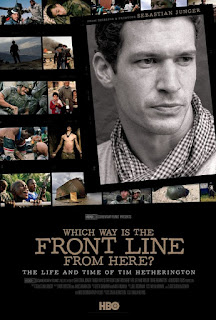
Which Way is the Front-line From Here?


When I was at Sheffield DocFest last year, I saw the Tim Hetherington Award go to Matthew Heineman, director of Cartel Land (which I'll review later). Awards like this not only exist to honour the memory of those they're named after by awarding the best documentarians of the time but they also function to introduce us newbies in the industry to the greats who came before us.

Following the award I set out to find out more about who Tim Hetherington was and came across Which Way is the Frontline From Here? There was something in this film that didn't just inspire me career-wise, but something that recognised the way I feel about about conflict. I am often asked how I can bear to watch documentary after documentary about pain, war and conflict and the only answer I've ever been able to give, is that in these films, I find more hope in humanity than I do, pain. To see humans struggle on, is something that always succeeds in getting me out of bed and committing to making a difference in the world somehow. Tim perhaps was different, it was his instinct, his nature, rather than just his passion. I have no experience to be able to know this yet. But this film shows certainly that he is someone to look to, when I think about my future.

foto8.com
Tim was a photojournalist, humanitarian and film-maker and his unique way of highlighting the plight of those often forgotten is a value I hold very dear to my heart. I have in fact just enrolled in a photography course to expand my field of vision through the lens. Tim travelled to many places, finding himself in situations he had not trained for, just felt equipped for. In Liberia, he captured the the story of war through sport. In Sierra Leone he captured those left without access to substantial healthcare and the victims of the fighters of the Revolutionary Front, who were left blinded. He found a way of capturing the stories of war that are often forgotten, through photographs that speak far louder than those we are used to in mainstream media.

pinterest.com
slate.com
artnews.com
Tim also managed to find friendship amidst the situations he found himself a part of. As his friend James put, 'he wasn't a humanitarian, or a journalist, or a photographer, he was just Tim'. He was unafraid of immersing himself in conflicts, he even stepped in to save a doctor's life when guns were pointed to his head - an act according to friends only Tim could have got away with. Then in Afghanistan, he again found himself at home within an angle of war, this time with the US army. Here he captured men in a place where they were allowed to love one another, and found innocent boys sleeping in their beds rather than the killing-machines they are often described as. Tim, despite the subject, always found the humanity in his photographs.

He continued to do so to his last moment as he chased towards the front-line in Libya, where he was killed by mortal fire alongside fellow photojournalists and civilians.

I find myself unable to say much more, how can I possibly review the making of a documentary capturing the life of a man whose job it was to do just that. The film captured moments of Tim's life we would not have seen without knowing him personally, with footage that showed him for the man he really was, a man who only ever had time for people above any form of standard journalistic practice. I'm glad I was there to see the Tim Hetherington Award presented in Sheffield, or perhaps I might never have known about the man he was and may never have learned from him the values I want to be a part of my own career in the future.

theguardian.com

Wednesday, 2 December 2015

So it Goes...

I had originally planned to spend the afternoon with a friend but with his final get-out calling to him I found other ways to entertain myself instead. Carting around my suitcase and two bags I power-walked from the infirmary to the Underbelly to catch the well-reviewed show, 'So It Goes'.

edinburghshowcase.britishcouncil.org
Family seemed to be a running theme with all of the shows I managed to see this year but in this one in particular, we were thrust into a world of family relationships that seemed all too familiar. The piece is based on a story following the journey of Hannah, mourning the death of her father. As she struggles to speak about her grief in the 7yrs that follow, she instead turns her focus to moping on the sofa and nights out on the town until finally she finds a way back to her mother. It was the second show I caught at the Fringe this year to avoid speech entirely, leaving a magnified emphasis on the visuals - which were bursting with originality and symbolic of the inability to see black and white at times of emotional difficulty.

incomingfestival.com


Facial expressions were at their best in this one, there was plenty of energy despite the subject matter and lack of dialogue. The show also featured lots (And lots) of whiteboards as important parts of the story were written for the audience to see - allowing us into our protagonist's world (and I applaud them on managing to write upside down)!

theartsdesk.com
We were drawn in with a high energy beginning, with enactments of memories of dad running everywhere, to work, to the shop, around the park. Dad loved to run. And our girl loved dad.

Line drawings were a huge part of the character of this show. Not only did it act to aid scene changes, explain narrative or act as scenery - it also had a kind of symbolic nature, representing the many childlike emotions that can present post-trauma. There was also something harrowing about seeing the solitary word 'cancer' written on one of the cards aided by an x-Ray like drawing of dad's insides. Despite the impact of the negative, these drawings also suggested a childish quality in our characters that gave them life and enabled us to really feel sympathy for them.

eastendreview.co.uk
I particularly enjoyed the club scene, with buckets of energy from our two actors (and buckets to catch the amount of sweat produced too), and with line drawings to represent the crowd and drinks - it was as clever visually as it was emotionally climatic. This was the moment for me that made the most sense when it comes to mourning - as we turn our energy to losing our minds and finesse the art of distraction. It's a routine I've practiced and one I could really connect with.

So it Goes... was brutally powerful. I am very much a woman of words and I find it much easier to write them down, rather than share them with anybody out loud. The show was a perfect embodiment of grief, of memory and of moving on. It was warm, it was fragile and it was human, which made it a hit at the Fringe this year and I hope on bigger stages to follow.

Find out more about the story behind the show here: http://www.ontheruntheatre.co.uk/#!current-production/cb3i

Dreams of A Life

We all dream of that life we wished we'd have led, we all dream of becoming someone better, or wealthier, but film-maker Carol Morley takes that dream one step further. She assumes the dream of Joyce Carol Vincent, a lady found dead in her flat having laid there for three whole years. Morley turns this hopelessly sad situation into a film about a young woman with lots of friends and lots of dreams, with vibrancy and life seeping through the screen.


production-designer.co.uk

campfilms.co.uk
It is at heart, an art-film with an essence of docudrama to fill in the gaps of Joyce's story where there is no record. We do not meet her family. We do not know the whole story. In fact, there is a total lack of any solid evidence of how Joyce spent her time and how troubled she really was. Yet, amidst such a lack of information about her, we are presented with a film that is full of character and one that acts as a respectful memorial to her life.

Carol Morley 's affection for the story is evident in her production. The careful casting of the beautiful Zawe Ashton and the genuine shock of the contributors we meet along the way, on hearing about Joyce's fate almost draw us to keep watching. We want to know what they wish to know, how this beautiful, apparently life-loving girl, came to be forgotten.


madman.com.au
moviemail.com
cineplex.com

The aesthetics were perfect - shadowed rooms in which Joyce always carried a glow. SFX of dripping taps and old 80s music adding character even to stone walls. We have all had moments in our lives where we pretend to be happy, where we tell others (and ourselves) that we are fine, but there is a deep wound that Joyce was hiding and although we're never quite sure which of her experiences hurt her most, we cannot tear our eyes away from trying to work it out. We watch her miming to her beautiful reflection in the mirror, we hear recordings of her singing. Joyce is living and breathing in the film, without ever actually being there. As an audience we want to save her, to reach into the screen and to be her friend, for the story not to be real. We want her to be remembered and Morley in this, does beautifully. 

We find ourselves stunningly moved by a news article that we may have perhaps glanced over before. Suddenly the story is a life, and the life is one we care about.


theartsdesk.com
I can't say much more, but the intimate and tragically beautiful dramatisation of Vincent's life, carried by the painful interviews of those who knew her, is just a wonderful and respectful memorial, to a young woman who met with tragedy. It is one of the most incredible factual films I've seen in the last few years, particularly surprising as there is, as the situation suggests, a significant lack of fact. I feel as though we pay our respects to Joyce and many others like her we will never know about, when we watch this film.

Joyce Carole Vincent

Sunday, 22 November 2015

Mwathirika

threeweeks.co.uk
My last trip to the Fringe in 2011 took me to an incense-infused-caravan, with pillows as seating, to a performance by The River People with some of the most captivating puppetry I'd ever seen. I'd never really cared for shows about puppets but their performance of Little Matter opened my eyes to just how magical it can be. The storytelling really spoke to me and it remains one of the greatest theatre productions I think I've seen.

threeweeks.co.uk

Little Matter's magic then took me to the Little Angel Theatre in East London where I found puppetry tackling stories of the holocaust (Buttons) and of a charming relationship between man, woman and fish, accompanied by the diagnosis and subsequent journey of discovery brought by Motor-neurone disease (Cell) - also at this year's fringe.

This year, I was back in Edinburgh again and I quickly sought out my next magical puppetry experience - I found it at C Nova.


aroundyou.com.au
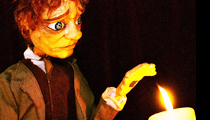
'Mwathirika', (meaning 'victim') was marketed as an Indonesian puppet show following two village families during the Indonesian genocide, in association with the British Council. It was the first time I'd seen child puppets and they got the physicality just right. Immediately some kind of maternal instinct kicked in as I watched the relationship between two young brothers fluctuate between self-pitying tantrums and complete idolisation in mere moments. With no dialogue to drive the story, all eyes were drawn to navigating our own individual journeys through the performance and these boys were central to it. You can't help but be charmed by the childish laughter and playful skipping of main character 

theaustralian.com.au


We watch as a nation is ripped apart and friends are isolated by an unjust regime. Children lose a father. A father shows his love for his daughter. Soldiers play the puppeteers of a nation as they themselves are puppets to a regime. A girl tries to help a friend and a boy is left alone.

heraldscotland.com


The Indonesian theatre company had mastered puppetry, with vocalisations of excitement and child's play spot on, as they even operated puppets with their toes.! I was transported. I was there with them. My heart wrenched for them. During the show the boys' father is arrested under the regime and they are left alone. At this point the pain that they feel is thrust into the hearts and minds of the captured audience. As they shiver, starve and cry, lose all hope - every ounce of humanity in you is reaching forward as if to scoop them up. It continues scene after scene, aided by projections of an endless tally chart and the execution of less animated movement, prolonging the feeling of an eternity of suffering. 

theaustralian.com.au
As the youngest child is left alone, the young girl from next door makes touching attempts to cheer him up as she wheels over in her wheelchair and gives him her music box. This was another first for me, seeing a puppet in a wheelchair and not thinking twice about it because it was choreographed so superbly. There were moments of audience participation, of light and dark and of a fairytale filled with hardship, loss, love and and friendship and it was captivating to watch the wooden puppets come alive as children. 

The performance almost had a heartbeat of it's own, you could tell the puppeteers were invested in their story and why not. I feel drawn to learn about Indonesian culture in a way I haven't been since the magnificent documentary 'The Missing Picture'.


I think you can tell, I was suitably impressed and for one evening of an unbelievably busy week, whilst my friends were off drinking, I found myself transported deep into the beautiful heart of an injured Indonesia and found triumph in facing it head on. I even got to get acquainted with one of teh characters!

The Fringe did it again, it holds the gold medal for puppetry for 2015 and I can't wait to see what it has in store for me next year! 

Follow Papermoon Puppet Theatre's work here: http://www.papermoonpuppet.com/

Saturday, 21 November 2015

Reclaiming Vietnam

By this point in the week I was more than a little worse for wear, speed napping whenever I found myself in low light. It was in this tragic state that I accidentally stumbled into Reclaiming Vietnam and happened across my second one woman show of the week.

Bacchic - windsorexpress.co.uk
The first one woman show I ever saw was 'Bacchic' back in May 2008, and although it boasted aerial acrobatics - I was not a fan of the Euripides-based story (nor can I even remember it). This time, I had allowed myself to be more open. Kim Chinh's story was different, she was about to express her own autobiographical story.

As is common at the Fringe you find yourself with tickets to shows you have heard nothing about. You have no idea of what to expect and only have the title of the piece to guide you in your estimations. I had expected to be met with a journey through Vietnam, to learn about the war and to see how it had injured its people. Instead I was thrust into the world of an American and her extended family. Not what I had expected but I ran with it.

edinburghfestival.list.co.uk
Kim began with telling us what she thought about Vietnam and how she dislikes being called Vietnamese. She calls Vietnam backwards, claiming 'I am American' - almost undermining her journey towards loving it before it even really begins. It meant I wasn't really sympathetic with her from the outset, I was annoyed by her for a bit. Why does she hate being Vietnamese? But what was unclear and a little annoying at the beginning did slowly begin to make sense as the piece continued.

It was a piece less about reclaiming her heritage, than forgiving her own family for abusing her trust. She enacts in depth her encounters with three of her cousins as she faces them and tells them that she remembers what they did - they had abused her and molested her and she wanted them to know she had not forgotten. It suddenly became a very personal journey across a backdrop that provided the distractions of war and worry, allowing her childhood abuse to go unnoticed.


reclaimingvietnam.com
I do still struggle with solo shows, interactions with others is part of human nature and body language suggests more about these journeys than a single person can ever give on their own. It was also a little disconcerting to see her confronting her past, but not really confronting her past. It was almost her having discussions with herself in the mirror, rather than her facing up to the men who had betrayed her trust. But then simultaneously, for those more intimate family moments I almost understood it - how can you possibly reenact those intricate and fragile moments of confrontation? I do however, feel it would have been beneficial to share her journey through Vietnam with her travelling partner in the flesh and allow us a break in a rather challenging journey.

reclaimingvietnam.com

The one thing the show achieved was that it did not paint our protagonist as a victim, she was self-aware and looking for answers and at no point did we blame Kim for her past - as is common in cases of abuse. But sometimes this almost worked against her, she would take us back to those moments of fun and lightness. She was dealing with the heavy bits and then distracting us, which perhaps has been the way she herself has moved on from it leaving you to question whether or not she has totally dealt with it or not. But this is less the question I left asking myself. The show was just a little misleading. It led us down the alley of discovery in Vietnam but was cloaked in another story of healing, leaving the Vietnam part, a little unresolved for me.


edinburghfestival.list.co.uk
Much of the piece was mimed. The motorbike Kim sped through Vietnam on, the phone she would call her cousins with, and so on. I'm almost sure that this was due to the artist having a small budget (I mean she'd already flown over from the US for us). But I think that solo shows need that extra aesthetic. I always certainly feel as though I need more to make up for the lack of other actors onstage. The show would certainly benefit from that when touring again.


Perhaps what makes the piece is the fact that the story is true, which perhaps suppresses our verdict as critics and instead opens our hearts to the human at the core of the piece. Not only is it extremely brave, but extremely affecting too, encouraging us to confront our demons and make peace with those things holding us back. Kim grasps her own truths and thrusts them in front of a public audience bearing all for us to judge. As a solo show, it offers a unique portrayal of a woman that has felt alone in her struggle for a long time, as well as offering up her strength in confronting it. Kim is certainly an inspiring woman and despite the reservations I had about the piece, that was the one thing I could not fault.

Kim spoke about her piece to blogger Gareth Vile here: http://vilearts.blogspot.co.uk/2015/06/kim-chinh-talks-dramaturgy-reclaiming.html 

Saturday, 10 October 2015

The Red Lion

southbanklondon.com
As I took my seat in the Dorfman Theatre, taking in the authenticity of Anthony Ward's set with its muddied walls and dirtied showers, it felt strangely familiar. The yearning I had to get myself back into one of those changing rooms - to struggle to pull my socks over my shin pads, bang my boots, to sit on one of those old battered benches - was pulling me in. The nostalgia was hitting me big time.

nationaltheatre.org
Daniel Mays lured us in further with his spectacular bitching about the state of the turf - especially around the goal-line - about referees, about pitch misconduct (we all have a story about the time THAT ref heard us call him something we shouldn't). Mays had energy like you wouldn't believe, commandeering the stage like he'd trodden its boards a thousand times. He had grit and ownership - everything a manager normally possesses - minus the chewing gum.

The first half allowed us into this male world, seething with homoeroticism that is all but celebrated yet confidently exercised. The youngest of our three man cast was Calvin Demba - playing a wayward young kid with talent on a ball and a few secrets in tow. It wasn't just a game for him, football was the place he was in control, the bit of turf he owned and the place he shone beyond his usual parameters. If there's anything I recognise, its that. That feeling you get on the pitch where everything else drifts away and for 90mins you control your own destiny. Even if it's just in your own little sunday league bubble, it's yours and you're in charge. Even on those misty winter mornings in the playground, with visible breath, wearing just a cotton school shirt and freezing my tits off - because yes, I have those. I wanted to get out on that field instantly. I was getting restless in the theatre. I felt Jordan's frustration, his worries about his knee injury, his aggression at being asked to cheat. His awkwardness at getting his kit off for a massage from another man - not that he was the only one to strip of course, all three of our men had their moment. For an actor I've only seen as a gobby little bad boy in Channel4s Youngers (which I actually loved btw) - I was suitably impressed with his command over his character. I'm quite excited by where he might go next, he's definitely one to watch.

Our cast weren't left to make drama where it wasn't written - Patrick Marber's script provided an authentic peek into a world any footballer would recognise. The line 'your sorry soul is always there to pull you back', 'he's man marking you' sticks out as one of the best. Some lines came off as a bit OTT and cheesy, but if you've ever been in a changing room it's exactly the kind of fearless prose that eeks its way into every conversation pre and post match.


Once again I was left to admire the set during the interval, where stage hands delivered scatters of ankle tape, mud and a worn-kit, filling the room with the musty smell of sweat and TCP. Even attention was given to the clock on the wall, showing that match time was over as the light outside the windows had shifted around the set. I longed to be there for real, unwinding after a game, nursing swollen ankles, with the stench of wet boots unavoidably seeping from the car boot. Again though I was awoken from my dreaming and given a story of three men who lived and breathed their club - albeit in their own way.

nationaltheatre.org
The second half was the time for our oldest cast member Peter Wight to really come into his own. The club was all Yates had, a club built on fairness and support - contradictory to Kidd who would do anything to get ahead. Whether it's three points on match day or £3000 through a dodgy transfer he was always looking to maximise potential for his reputation at the club. But our Yates was having none of it, even if it meant getting his hands dirty in the process. And dirty he did. He fights to mentor young Jordan facing direct opposition from May's character, Kidd and this time, the score line didn't matter. The most intense match was going on inside the changing room - which is why the play gets away with never showing any character playing football. The drama is already there.

nationaltheatre.org
Yates wins our hearts with his passion but by the end we're not sure who has it right. All three men have lied in the name of the sport they love BECAUSE they love it. It's hard to hate anyone by the end. We have an odd sort of hero worship going on - or maybe we just empathise.

The finale of the piece was unexpected. As Yates becomes the last of the three to get his kit off, we watch as he once again abides by the routine the audience has accustomed to. Alone in the changing rooms he plugs the plug in the wall, unreels the extension cable - but this time he keeps going. He unreels it long enough to walk it into the shower room - without the club he has nothing left - and his final moments are driven home by the sharp reality of just how much the beautiful game means to people. Even our rivals conclude that they are in fact both the same.

Marber's script gave us all of passion-filled cliches we expected but it gave us something else too. A feeling of integrity amongst the lies and an empathy for anyone who puts their heart and soul into football, on and off the pitch. It was empowering and the first thing I did when I got home is get my kit ready for training. It seems so many of us escape to this muddy-walled changing room, and The Red Lion only made me realise how much I rely on it for sanity. A beautiful ode to a beautiful game with a soft spot for anyone who immerses themselves in club life and football fanaticism - even the groundsman with the dodgy goal line!